By Steve Raju
For Copywriters and Content Writers
Cognitive Sovereignty Checklist for Copywriters
About 20 minutes
Last reviewed March 2026
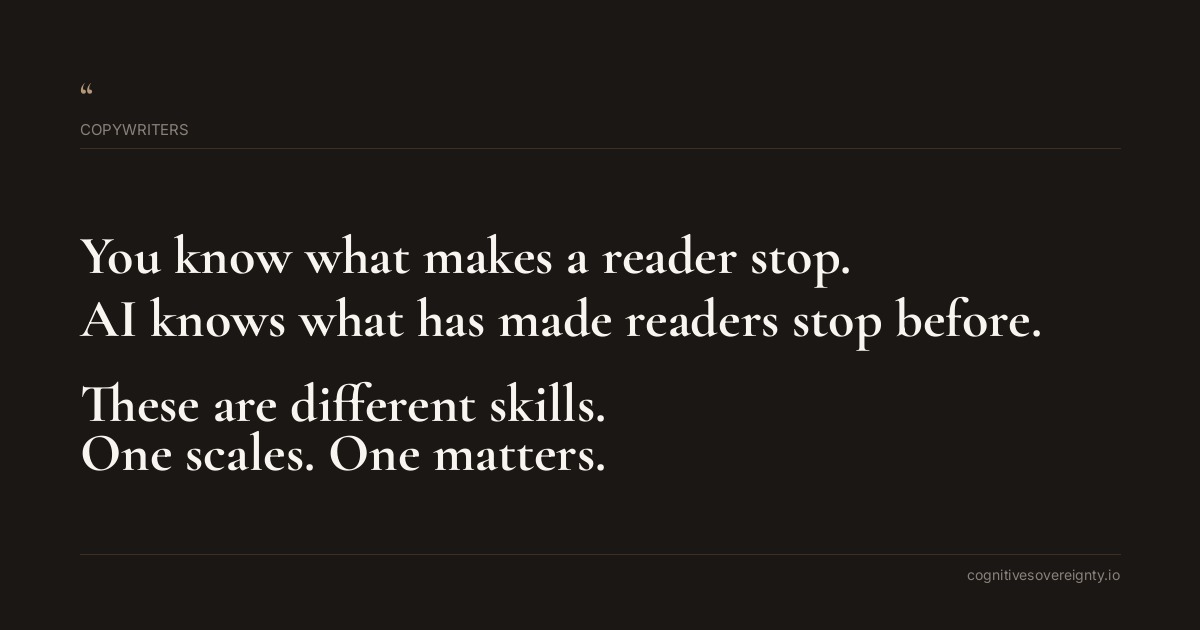
AI tools like ChatGPT and Claude have made the obvious answer instant and free. Your creative instinct for the contrarian angle, the surprising headline, the unexpected positioning is atrophying because you never have to hunt for it anymore. Without deliberate work, your writing voice becomes a average of what AI generates well, not what makes your clients' brands memorable.
Tool names in this checklist are examples. If you use different software, the same principle applies. Check what is relevant to your workflow, mark what is not applicable, and ignore the rest.
These are suggestions. Take what fits, leave the rest.
Tap once to check, again to mark N/A, again to reset.
Protect your contrarian instinct
Write three headlines before opening any AI toolbeginner
Your first instinct is yours. Once you see what ChatGPT generates, your brain anchors to its suggestions. Train yourself to spend fifteen minutes finding your own angles first, even if they feel weaker.
Intentionally generate the worst possible angle for your briefintermediate
AI will never suggest this because it optimises for competence, not controversy. The worst angle often contains a seed of the most interesting one. Spend five minutes writing something deliberately wrong to see what it reveals.
Save headlines that made you wince or laughbeginner
These are the ones outside the normal distribution. When you feel resistance to a line, that is where your edge lives. AI rarely produces copy that makes anyone uncomfortable, so collect the moments when yours does.
Audit your last five pieces for clichés that AI suggestedbeginner
Look for phrases like 'unlock potential' or 'transform your business'. Copywriters who rely on AI's first drafts start sounding identical to their competitors. Identify which weak lines came from the tool, not from you.
Deliberately choose the less obvious verb in your positioningintermediate
AI prefers high-frequency verbs like 'help', 'enable', 'deliver'. Your brand's voice lives in the specific verb choice. If you are writing about software for accountants, 'wrangle' data instead of 'organise' it. Test the unusual choice first.
Keep a swipe file of copy that surprised you for the right reasonsbeginner
Not AI copy. Human copy that made you think differently about a problem. Review it monthly to remember what unpredictable writing looks like. This trains your eye to recognise when you are settling for competent.
Reject the AI suggestion that feels most sensibleadvanced
When Claude suggests the obvious positioning, ask yourself why. Then write the opposite argument. Half the time, that exercise reveals a stronger angle than the default one.
Maintain a voice AI cannot replicate
Write in your actual speaking voice, then refine itbeginner
AI-assisted copy often loses personality because you are editing from a neutral draft. Start by writing as though you are speaking to the client over coffee. Your cadence, your opinions, your humour belong in the first draft.
Use one specific reference or anecdote per piecebeginner
AI will not generate your memory of a client interaction or a moment from your industry. One concrete detail that only you would know makes copy unmistakably human. This is what clients are actually paying for.
Limit yourself to one tool per projectintermediate
If you use ChatGPT for ideation and Claude for refinement, your copy becomes a blend of both outputs. Stay consistent with one tool to understand its particular bias, then deliberately work against it.
Identify your three strongest stylistic choices and defend themintermediate
Do you prefer short paragraphs or long ones? Do you use numbers or spell them out? Do you address the reader as 'you' or by their role? Make these choices consciously, then resist AI's pressure to 'balance' them. Your quirks are your brand.
Never accept an AI revision without understanding why it changedbeginner
Grammarly AI might suggest a passive voice change that removes the energy from your copy. Know what you chose and why. If the tool changes it, restore your choice intentionally.
Write the email or message you would send to the client without AIintermediate
That version has your true voice. Compare it to your AI-assisted version. Notice what the tool removed. Restore at least one element that makes it sound like you.
Rebuild the judgement AI is replacing
Test your copy against your brand voice document before testing against dataintermediate
Clients increasingly ask if AI-written copy is cheaper. You prove it is not by showing they can get AI copy anywhere, but they cannot get their specific voice anywhere. Measure copy against brand consistency first.
Spend one hour per week reading copy you admire that is not in your categorybeginner
AI is trained on what exists. You train yourself by looking sideways. Read a healthcare brand's copy, then a whisky brand's copy, then a B2B SaaS brand's. This expands what you can imagine generating.
For every brief, write a positioning statement AI would never suggestadvanced
AI optimises for broad appeal. Write one that is deliberately narrow. One that says 'not for everyone'. Then decide if that boldness is right for this client. This is the judgement AI cannot make.
Show clients two versions: one AI-assisted, one with your thinking restoredadvanced
Let them see the difference. Point out where you rejected the obvious angle, where you chose a specific verb, where you added your voice. This is what they are paying for. This builds the case for human copywriting.
Ask 'Would AI suggest this' before keeping any lineintermediate
If the answer is yes, rewrite it. Your job is to produce what AI cannot, not faster versions of what it already does. This one question sharpens your editorial instinct.
Rewrite one paragraph three different ways without using AIbeginner
This trains you to see options. AI gives you one good answer. You need to see five. Spend fifteen minutes exploring before you touch any tool.
Defend one creative choice to your client in writingadvanced
Why this headline instead of the obvious one. Why this verb instead of the safer one. This forces you to articulate your judgement. It also proves to clients that human thinking is happening.
Five things worth remembering
- Your voice is not something AI improves. It is something AI dilutes. Protect it by never letting the tool's first draft become your starting point.
- The moment a client asks 'Can you just use AI for this', you have already lost the argument. Show them work where AI obviously did not do it, and they will stop asking.
- Keep a folder of your favourite lines you wrote without any tool. Review it before every project. This is your baseline for what 'good' sounds like when it is genuinely yours.
- The copywriters who stay valuable are the ones finding the angles AI classifies as too risky. Train yourself to see what the tool rejects as wrong, then ask why.
- Audit your copy for AI tells monthly. Phrases like 'ensure', 'seamless', 'cutting-edge', and 'innovative' are AI fingerprints. If they are in your work, you are thinking like the tool instead of like yourself.
Common questions
Should copywriters write three headlines before opening any ai tool?
Your first instinct is yours. Once you see what ChatGPT generates, your brain anchors to its suggestions. Train yourself to spend fifteen minutes finding your own angles first, even if they feel weaker.
Should copywriters intentionally generate the worst possible angle for your brief?
AI will never suggest this because it optimises for competence, not controversy. The worst angle often contains a seed of the most interesting one. Spend five minutes writing something deliberately wrong to see what it reveals.
Should copywriters save headlines that made you wince or laugh?
These are the ones outside the normal distribution. When you feel resistance to a line, that is where your edge lives. AI rarely produces copy that makes anyone uncomfortable, so collect the moments when yours does.