This page has everything you need to share, post, email, or talk about Cognitive Sovereignty and help it reach the people who need it. Take what's useful. Ignore what isn't. And thank you, genuinely.
Now available on Amazon · Kindle + Paperback
Best thing to share right now
The Cognitive Sovereignty Quiz
Two minutes. One question worth sitting with: are you still thinking for yourself? People share their result. That's the point.
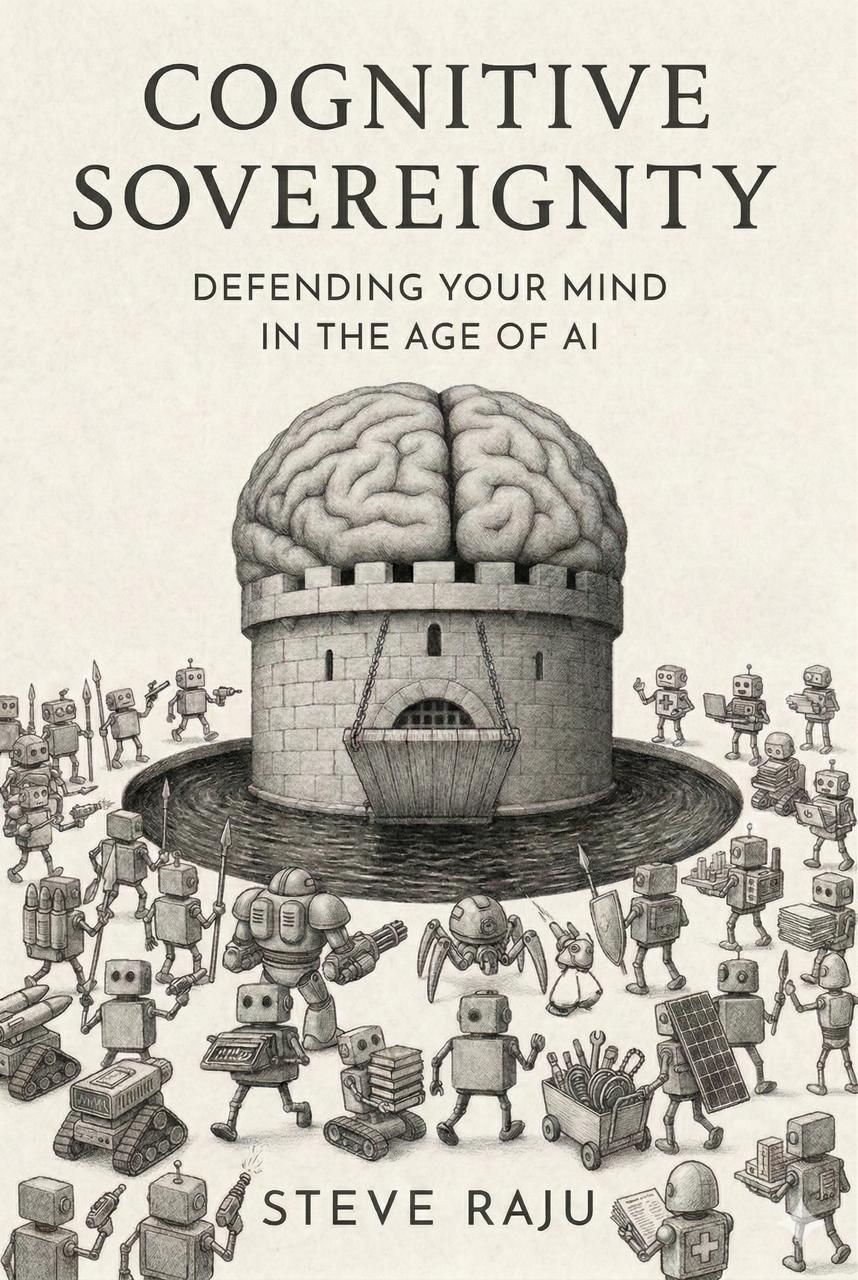
A brain sitting inside a medieval fortress, surrounded by an army of robots. Pencil sketch. It stops the scroll.
The Pitch
How to describe the book
Three versions, ready to paste. Pick the one that fits where you're sharing it.
One sentence
A sharp, readable argument that the most important thing you can protect in the age of AI is your own ability to think, and a practical approach for doing exactly that.
Short paragraph
AI is one of the most useful tools ever built. It's also doing something quiet and gradual to the minds of the people who use it. Steve Raju's new book, Cognitive Sovereignty, names that process "Cognitive Finlandization," drawing on Cold War history to describe what happens when you outsource your thinking, one small reasonable decision at a time, until the sovereignty is yours in name only. It is available now on Amazon.
Longer description
During the Cold War, Finland navigated its relationship with the Soviet Union through a strategy of careful, principled engagement. It never surrendered outright, and it never pretended the pressure wasn't real. The West called it Finlandization when other countries failed to do the same, maintaining the appearance of independence while deferring to Soviet influence in every decision that actually mattered.
Steve Raju's new book Cognitive Sovereignty applies that same approach to the relationship between human minds and AI. The central argument: we are all, to varying degrees, undergoing Cognitive Finlandization. We outsource our thinking one small, reasonable decision at a time, and the sovereignty we believe we still have exists increasingly on paper. The book is a map of what's at risk, a clear-eyed account of how the erosion happens, and a practical guide for people who'd like to do something about it before the capacity they're losing is too far gone to recover. Available now on Amazon.
The Core Concept
What is Cognitive Finlandization?
When someone asks what the book is about, here's the version worth stealing.
Cognitive Finlandization
During the Cold War, "Finlandization" described countries that preserved the appearance of independence while deferring to a more powerful neighbour in every decision that actually mattered. The sovereignty was nominal. The flag was theirs. The decisions weren't.
Cognitive Finlandization is the same process, applied to your mind. You're still present. You're still producing outputs. The actual thinking, the synthesis, the judgment, the originality, has quietly migrated somewhere else. Nobody forced it out. It went because each time, letting it go was easier than keeping it. And each time, it got a little easier still.
During the Cold War, "Finlandization" described countries that preserved the appearance of independence while deferring to a more powerful neighbour in every decision that actually mattered. The sovereignty was nominal. The flag was theirs. The decisions weren't.
Cognitive Finlandization is the same process, applied to your mind. You're still present. You're still producing outputs. The actual thinking, the synthesis, the judgment, the originality, has quietly migrated somewhere else. Nobody forced it out. It went because each time, letting it go was easier than keeping it. And each time, it got a little easier still.
Shareable Graphics
Quote cards for social media
1080×1080 PNG — ready for Instagram, LinkedIn, Twitter, or anywhere. Click any card to download it.
Direct quotes from the book. The attribution is included when you copy.
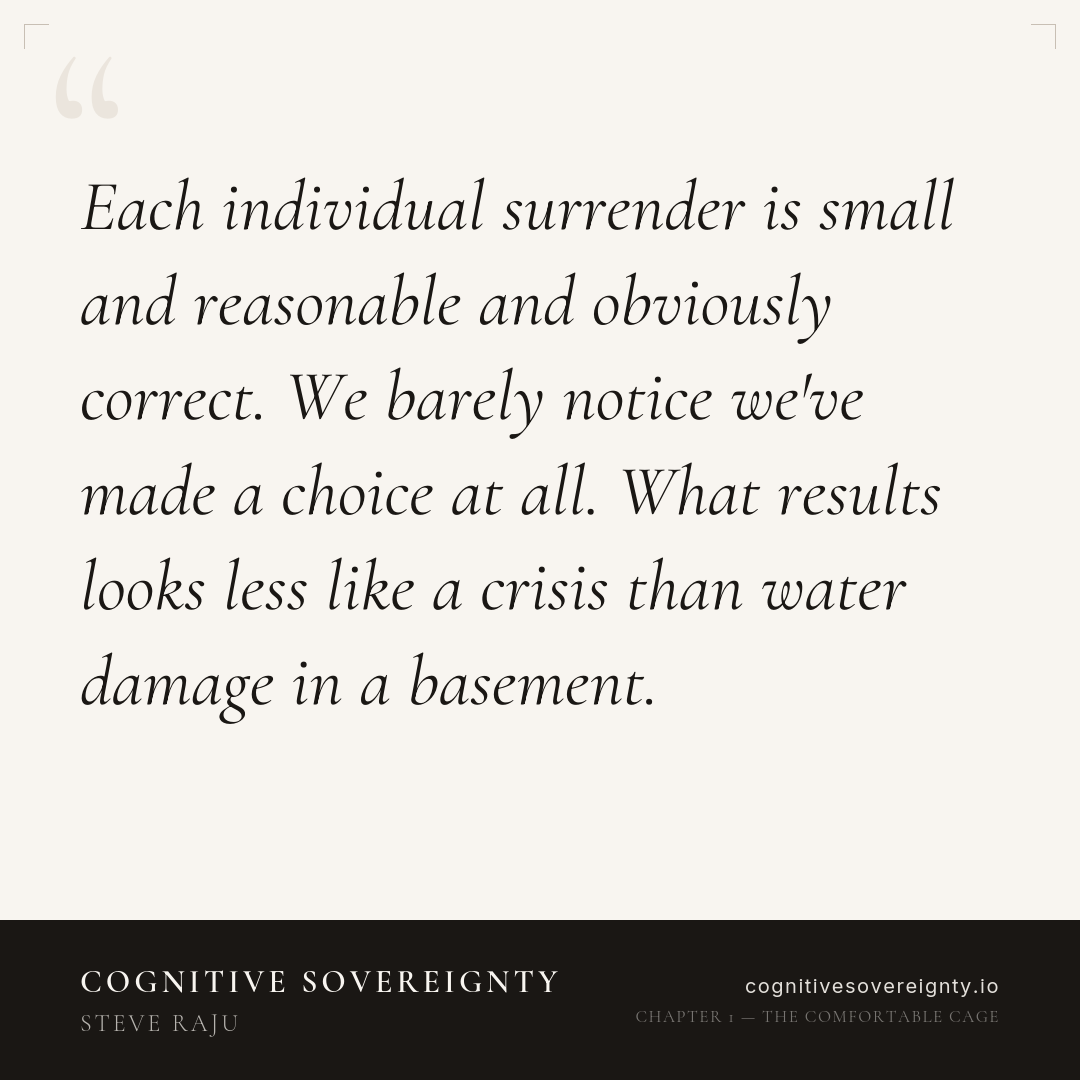
"Each individual surrender is small and reasonable and obviously correct. We barely notice we've made a choice at all. What results looks less like a crisis than water damage in a basement."
"Each individual surrender is small and reasonable and obviously correct. We barely notice we've made a choice at all. What results looks less like a crisis than water damage in a basement."
-- Cognitive Sovereignty: How To Think For Yourself When AI Thinks For You
Steve Raju
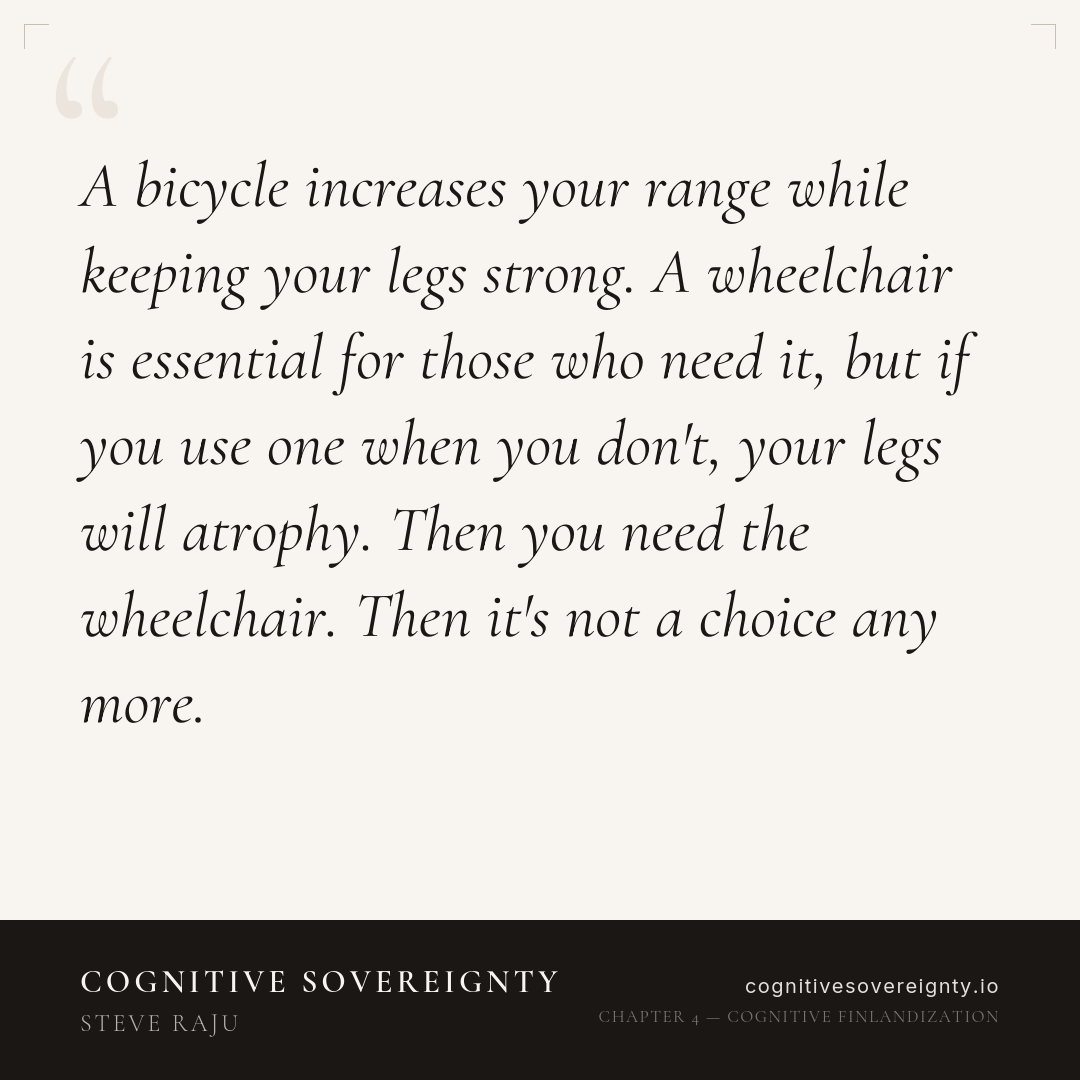
"A bicycle increases your range while keeping your legs strong. Steve Jobs used that metaphor, and he was right about this one. A wheelchair is essential for those who need it, but if you use one when you don't, your legs will atrophy. Then you need the wheelchair. Then it's not a choice any more."
"A bicycle increases your range while keeping your legs strong. Steve Jobs used that metaphor, and he was right about this one. A wheelchair is essential for those who need it, but if you use one when you don't, your legs will atrophy. Then you need the wheelchair. Then it's not a choice any more."
-- Cognitive Sovereignty: How To Think For Yourself When AI Thinks For You
Steve Raju
"The dependency sneaks up on you. It doesn't announce itself. It just sits there, warm and comfortable, until one day the satellites are down and you're lost in a neighbourhood you've driven through five hundred times."
"The dependency sneaks up on you. It doesn't announce itself. It just sits there, warm and comfortable, until one day the satellites are down and you're lost in a neighbourhood you've driven through five hundred times."
-- Cognitive Sovereignty: How To Think For Yourself When AI Thinks For You
Steve Raju
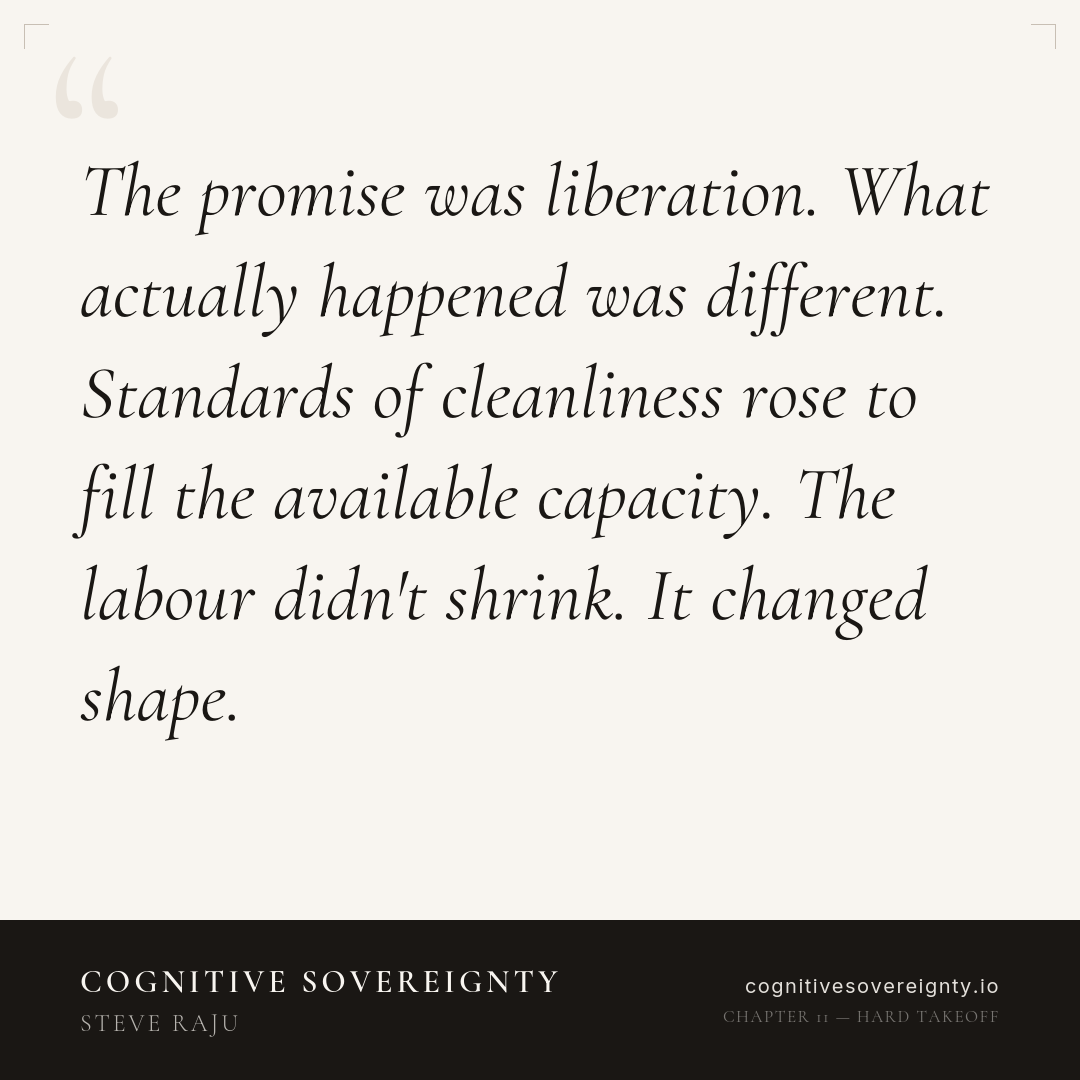
"The promise was liberation. Women's magazines ran articles with titles like 'Making Housekeeping Automatic.' The drudgery would vanish. All that freed time would be available for education, leisure, rest. What actually happened was different. Standards of cleanliness rose to fill the available capacity. The labour didn't shrink. It changed shape."
"The promise was liberation. Women's magazines ran articles with titles like 'Making Housekeeping Automatic.' The drudgery would vanish. All that freed time would be available for education, leisure, rest. What actually happened was different. Standards of cleanliness rose to fill the available capacity. The labour didn't shrink. It changed shape."
-- Cognitive Sovereignty: How To Think For Yourself When AI Thinks For You
Steve Raju
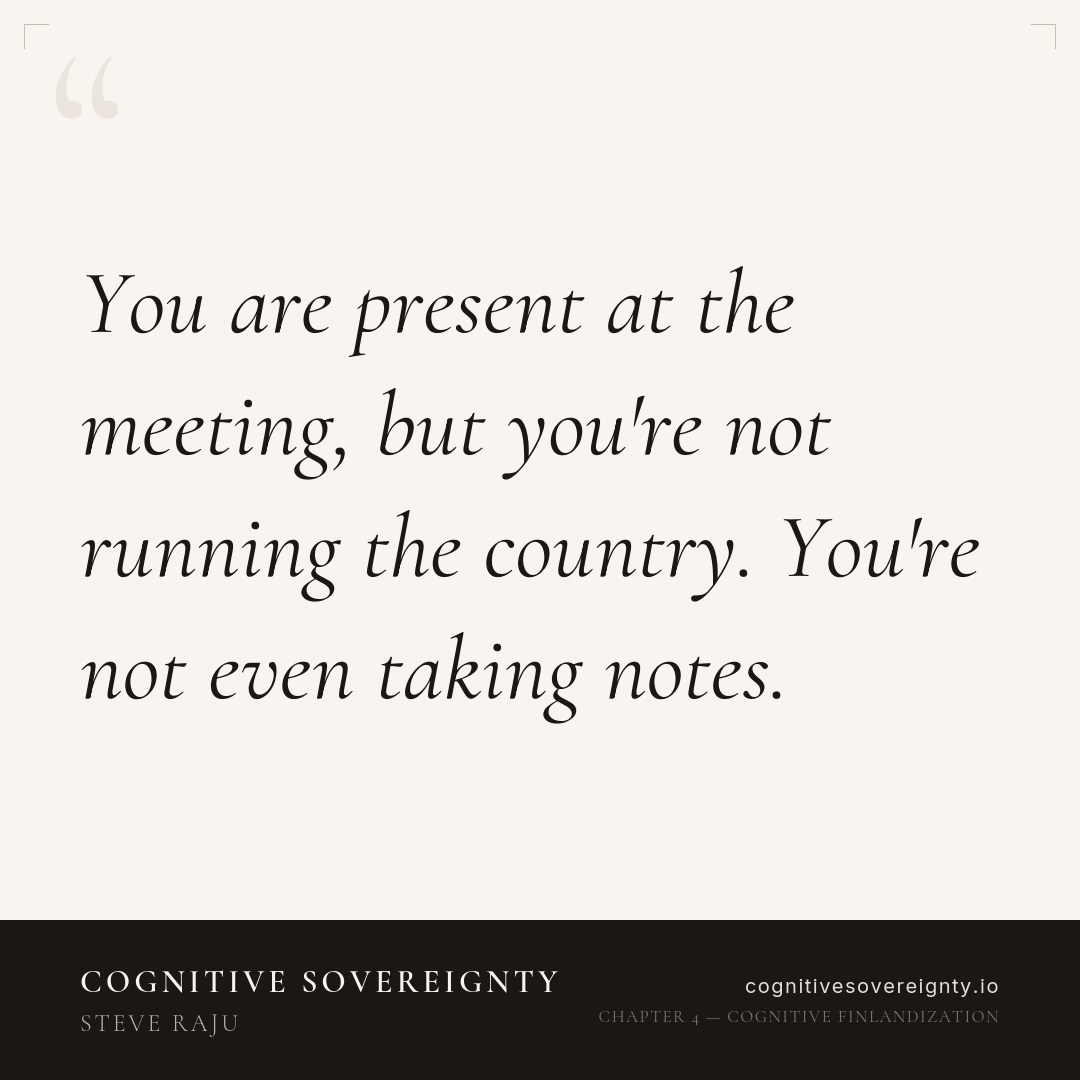
"You are present at the meeting, but you're not running the country. You're not even taking notes."
"You are present at the meeting, but you're not running the country. You're not even taking notes."
-- Cognitive Sovereignty: How To Think For Yourself When AI Thinks For You
Steve Raju
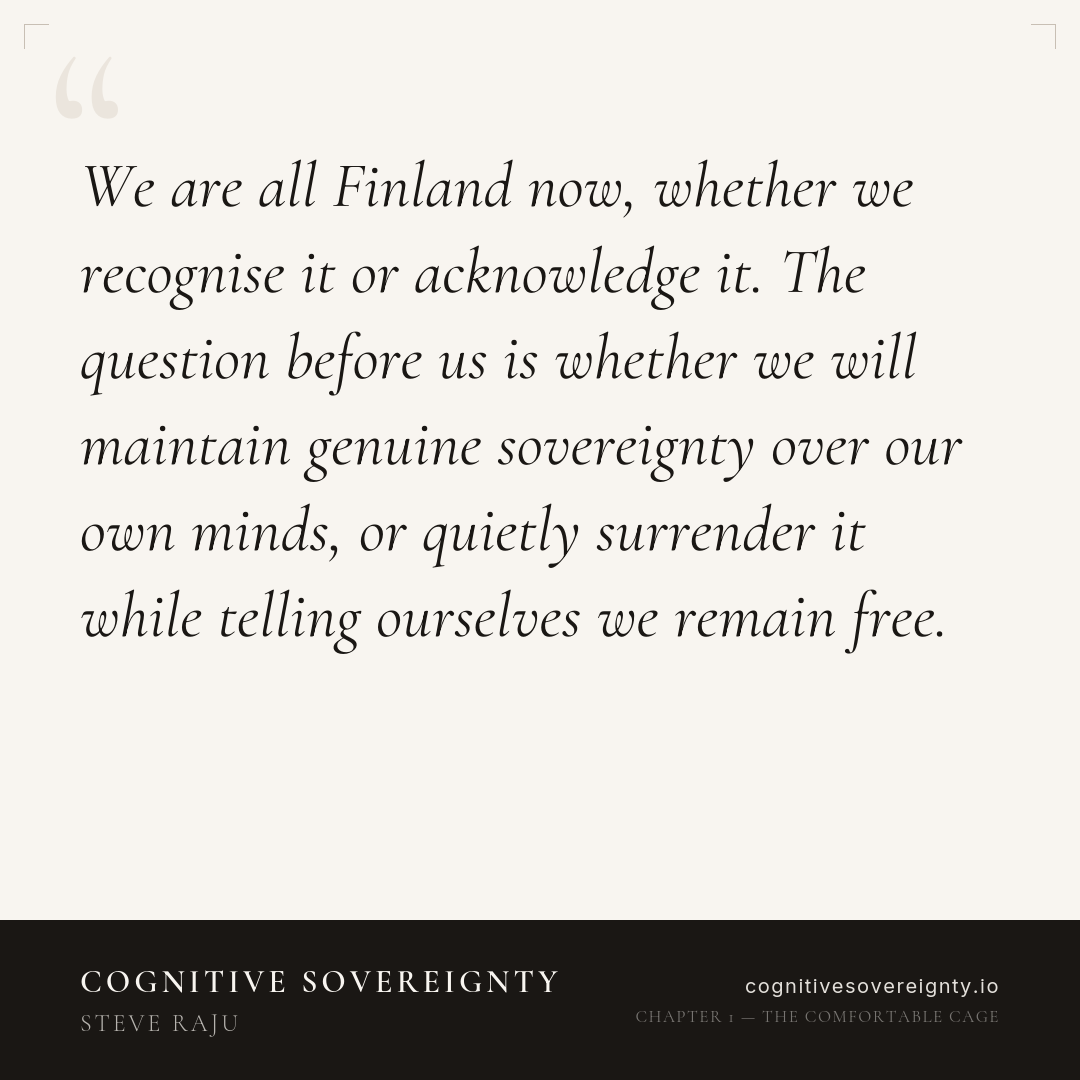
"We are all Finland now, whether we recognise it or acknowledge it. The question before us is whether we will maintain genuine sovereignty over our own minds, or quietly surrender it while telling ourselves we remain free."
"We are all Finland now, whether we recognise it or acknowledge it. The question before us is whether we will maintain genuine sovereignty over our own minds, or quietly surrender it while telling ourselves we remain free."
-- Cognitive Sovereignty: How To Think For Yourself When AI Thinks For You
Steve Raju
Social Media
Ready-to-post copy
Adapt the voice to sound like you. The structure and message are ready. Post any time.
Twitter / X — short
This book introduced me to a concept called "Cognitive Finlandization," and I haven't stopped thinking about it since.
Cognitive Sovereignty by @SteveRajuLTQ is out now. First chapter free: cognitivesovereignty.io
Twitter / X — with hook
Are you still thinking for yourself?
A new book makes the case that most of us are quietly outsourcing our thinking, one small reasonable decision at a time, until the sovereignty we believe we have is ours in name only.
Cognitive Sovereignty by @SteveRajuLTQ. Out now. Free chapter: cognitivesovereignty.io
LinkedIn
Something worth your time, especially if you use AI tools in your work.
A new book called Cognitive Sovereignty, by Steve Raju, introduces a concept called "Cognitive Finlandization." The argument: every time we let AI handle our thinking, we run a small experiment on our own cognitive architecture. The results don't show up immediately. They show up later, like sun damage or a slow leak.
Steve draws on Cold War history, neuroscience research, and his own years of working across AI and human performance to map what's at risk, and what to do about it.
First chapter is free at cognitivesovereignty.io. Available now on Amazon.
Instagram caption
Most of us use AI every day. Few of us have asked what it's doing to our ability to think without it.
Cognitive Sovereignty by Steve Raju answers that question, with Cold War history, neuroscience, and a practicality that most AI books completely miss.
Out now. First chapter free at cognitivesovereignty.io (link in bio)
#cognitivesovereignty #AItools #criticalthinking #books #artificialintelligence
Email Swipe
For anyone with a list or newsletter
Four angles depending on your audience. Adapt the opening line to sound like you -- everything else is ready to send. Each one also has a P.S. version for dropping into the bottom of a regular email.
Best for: AI, tech, and productivity audiences. This angle focuses on the invisible cognitive trade happening every time we outsource thinking to AI -- the cumulative drift that nobody notices until it matters. Works well for thoughtful, intellectually-engaged lists.
Full email
Subject: Are you still thinking for yourself?
I want to tell you about a book that's been sitting with me.
It's called Cognitive Sovereignty: How To Think For Yourself When AI Thinks For You, by Steve Raju. Out now on Amazon.
The core idea is something Raju calls "Cognitive Finlandization." Every time you let AI handle something you'd normally think through yourself, a small transfer happens. The thinking migrates outward. Your capacity for that particular thing shrinks a little. Each instance is so reasonable it barely registers. The cumulative effect is something quite different -- like water damage in a basement that nobody noticed until the floor gave way.
Steve draws on GPS research, Cold War history, and years working with AI tools professionally to map exactly which thinking ability are most at risk, and what a practical defence actually looks like.
The first chapter is free, and it's worth your time: cognitivesovereignty.io
P.S. version
P.S. A book worth your time: Cognitive Sovereignty by Steve Raju (available now on Amazon). It's about what AI might be quietly doing to how we think -- and what to do about it. First chapter free: cognitivesovereignty.io
Best for: business, entrepreneurship, and professional development audiences. Frames the book as a competitive advantage play. The people who keep their judgment sharp while everyone else outsources theirs will be irreplaceable. Practical, forward-looking, not preachy.
Full email
Subject: The skill everyone is quietly losing
Quick one for you.
There's a divide forming in the professional world, and most people won't notice it until it's already decided.
On one side: people who've handed most of their thinking to AI. Faster output, lower effort, increasingly indistinguishable from each other.
On the other: people who kept their judgment sharp. Who still work through hard problems themselves. Who can tell when the output is wrong, and why.
A book that maps this territory better than anything I've read. It's called Cognitive Sovereignty: How To Think For Yourself When AI Thinks For You, by Steve Raju.
Raju's argument is specific and well-evidenced: every task you outsource to AI shrinks the cognitive muscle that would have done it. The process is gradual, invisible, and entirely reversible -- if you catch it in time. His book explains which capacities are most worth protecting, and how to protect them without becoming a Luddite about it.
Not anti-AI. He uses the tools professionally. This is about being strategic rather than wholesale about what you hand off.
Worth 10 minutes of your time: cognitivesovereignty.io (first chapter free)
P.S. version
P.S. Cognitive Sovereignty by Steve Raju -- out now. The case that judgment is your last real competitive edge in an AI-saturated world, and a practical guide to keeping it. First chapter free: cognitivesovereignty.io
Best for: self-improvement, productivity, and wellness audiences. Draws a direct parallel between physical fitness and cognitive fitness. If you don't use a capacity, it weakens -- your brain follows the same rules as your body. Resonates with audiences who already invest in themselves.
Full email
Subject: You train your body. What about your mind?
Something I've been thinking about lately.
You know that if you stop exercising, your fitness drops. You know that if you only eat junk, your energy suffers. The connection between input and capacity is obvious when it comes to the body.
Your brain follows exactly the same rules.
A book that makes this case in a way I haven't seen before. It's called Cognitive Sovereignty: How To Think For Yourself When AI Thinks For You, by Steve Raju.
The research Raju cites is striking. People who rely on GPS struggle significantly more to learn new routes from memory. Surgeons who outsource procedural judgment to guided systems make more errors when the technology fails. In both cases, the capacity wasn't lost all at once. It drifted -- use by use, choice by choice, over months and years.
Raju's book is about figuring out which mental capacities are most at risk from AI reliance, and building the habits that keep them in shape. Not by rejecting AI -- by being deliberate about what you keep for yourself.
Think of it as a fitness plan for your thinking.
First chapter is free: cognitivesovereignty.io
P.S. version
P.S. Cognitive Sovereignty by Steve Raju -- out now on Amazon. About the mental capacities that AI quietly erodes if you let it, and how to keep them sharp. First chapter free: cognitivesovereignty.io
Best for: independent thinkers, tech-skeptic audiences, and creators who push back on mainstream narratives. Acknowledges the AI enthusiasm without dismissing it -- then asks the question everyone's avoiding. Works well for audiences who pride themselves on thinking differently.
Full email
Subject: Everyone says use more AI. This book asks a different question.
You've seen the posts. Use AI for everything. Automate everything. Move faster. The only sin is doing something yourself when a model could handle it.
There's a book that's the first one I've seen to ask what we might be quietly giving away in that arrangement.
It's called Cognitive Sovereignty: How To Think For Yourself When AI Thinks For You, by Steve Raju.
Raju isn't anti-AI -- he uses the tools professionally and knows them well. But he's noticed something most AI enthusiasts aren't talking about: every capability you hand off gets a little harder to reclaim. The process is gradual enough that you don't notice it happening. His term for the full version of this is "Cognitive Finlandization" -- a slow, reasonable, almost invisible accommodation that leaves you dependent in ways you didn't consciously choose.
This isn't a warning. It's a practical guide to staying sovereign -- keeping the cognitive territory that actually matters to you while still using the tools that make sense.
The first chapter is free. Worth reading before you decide what you think: cognitivesovereignty.io
P.S. version
P.S. Cognitive Sovereignty by Steve Raju -- out now. The book about what you might be quietly giving away every time you let AI think for you. Not anti-AI. Just asks the question nobody else is. First chapter free: cognitivesovereignty.io
Steve Raju is an AI consultant and Chief AI Officer at HaloTree Technologies. He completed Stanford's Machine Learning Specialisation and lives in Vancouver with his family.
Longer — for podcast show notes or event introductions
Steve Raju has spent the last several years across AI and human performance. He completed Stanford's Machine Learning Specialisation, serves as Chief AI Officer at HaloTree Technologies. He noticed the pattern behind Cognitive Sovereignty in his own work, in the subtle, hard-to-name ways that constant AI use was changing how he approached problems. He lives in Vancouver with his family, uses AI constantly, and thinks you should too. Carefully.
Get in Touch
Reach Steve directly
If you want to coordinate, swap newsletters, pitch a podcast idea, or just say hello, Steve reads every message.
Email
Best for newsletter swaps, podcast invites, anything detailed