By Steve Raju
For Sports and Athletics
Cognitive Sovereignty Checklist for Sports and Athletics
About 20 minutes
Last reviewed March 2026
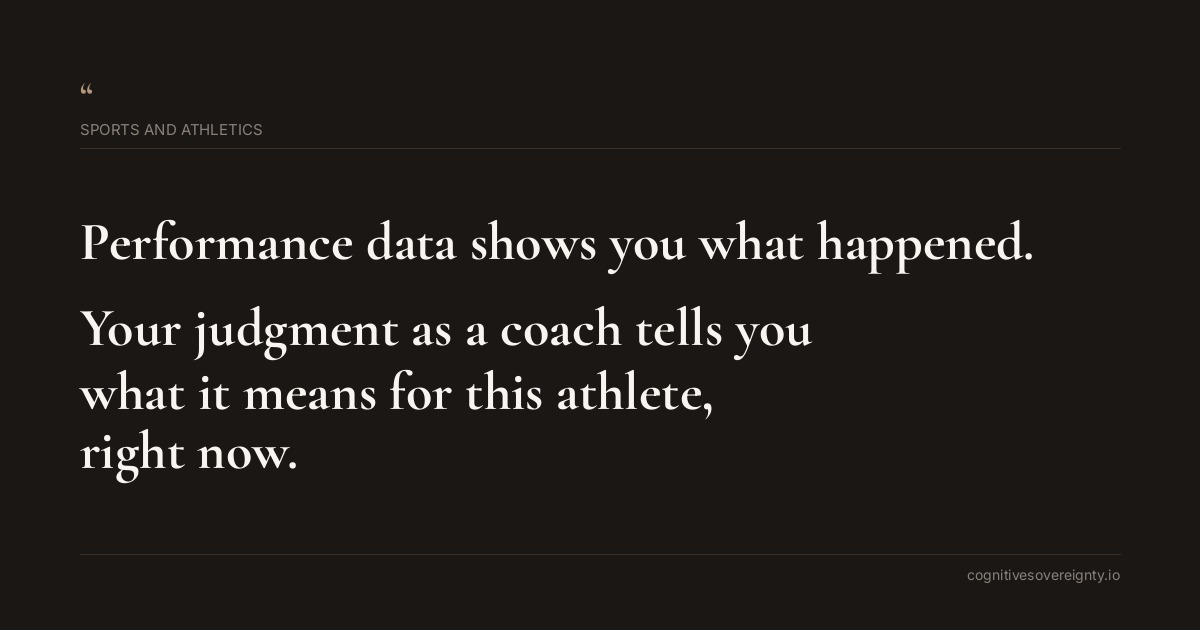
AI tools like Catapult, Second Spectrum, and Hudl analyse athlete data at scale, but they measure what is easy to measure. A player's willingness to compete when losing, their ability to lead under pressure, or their hunger in a contract year remain invisible to these systems. When your organisation treats athlete development, scouting decisions, and team selection as optimisation problems, you risk losing the human judgement that made your organisation successful.
Tool names in this checklist are examples. If you use different software, the same principle applies. Check what is relevant to your workflow, mark what is not applicable, and ignore the rest.
These are suggestions. Take what fits, leave the rest.
Tap once to check, again to mark N/A, again to reset.
Protect Scouting Judgement from AI Measurement Bias
Document what your best scouts felt about players AI ranked lowerbeginner
Keep records of players your scouts backed who had modest metrics but succeeded at elite level. This builds evidence of what your scouts see that systems miss. Review these cases before AI scouting tools make final recommendations on youth players or recruits.
Run parallel scouting processes instead of replacing human scouts with AI rankingsintermediate
Have your scouts identify prospects through traditional methods. Have AI identify separate prospect lists based on measurable attributes. Compare the lists afterwards. This shows you what each method catches that the other misses, rather than erasing human insight.
Audit your AI scouting tool for bias against specific playing stylesadvanced
Some positions and tactical approaches generate clean data. Others do not. A defensive midfielder who reads space does not sprint as much as one who chases the ball. Check whether your scouting AI systematically underrates players whose value comes from positioning, intelligence, or subtlety.
Ask scouts to justify AI recommendations they disagree with before accepting themintermediate
If a scout thinks AI got it wrong, force the scout to articulate why. This surfaces what they are seeing in person that the system cannot measure. These conversations often reveal which AI data points are misleading in your sport.
Assign a senior scout to review every AI-flagged prospect before contract offersbeginner
Do not let AI metrics alone decide whether to offer terms to a young player. A scout's in-person assessment adds information no dataset contains. This role costs money but protects your recruitment from optimisation errors.
Track long-term performance of players your scouts backed against players AI recommendedintermediate
Measure how each group performs three to five years after recruitment. If scouts consistently outperform AI or vice versa, you have evidence of what each method does well. Use this to decide how much weight to give AI recommendations.
Preserve Athlete Development Judgement Against Data Optimisation
Stop using AI performance data to make automatic playing time decisionsbeginner
Systems like Catapult and Whoop produce excellent injury risk and load data. They should inform coaching decisions, not replace them. A player performing poorly in metrics might be in peak mental state for a high-stakes match. Coaches need space to trust their read of the player.
Create a written rule about what athlete data AI can and cannot informintermediate
Decide in advance which decisions require human approval even when AI recommends otherwise. Examples: playing time for matches of high importance, contract renewals for senior players, whether an athlete needs mental health support. Write these boundaries down so AI tool recommendations do not creep into judgement areas.
Have coaching staff regularly disagree with AI recommendations out loudbeginner
Create a culture where a coach can say an athlete is ready to play despite concerning load metrics or that a player needs rest despite good statistical form. Disagreement should be normal and logged. This prevents coaching staff from deferring to the system by habit.
Assess athlete potential using coach observation separate from AI metricsintermediate
Once per season, have your head coach and senior assistants write assessments of young players without looking at any AI data. Compare those assessments to what the data says. This reveals whether coaches are seeing potential that metrics miss or whether they are overestimating.
Measure athlete motivation and character through structured interviews, not behavioural proxiesadvanced
AI tools infer motivation from load data or movement patterns. Instead, have coaches, sports psychologists, and captains interview athletes regularly about their goals and competitive mindset. These conversations generate information about what drives a player that no sensor captures.
Prevent AI recommendations on athlete psychology from reaching coaches unfilteredintermediate
Some performance systems attempt to infer mental state from physical metrics. This is dangerous. If a system suggests an athlete is losing focus or commitment, have a sports psychologist verify this through direct assessment before sharing it with coaching staff.
Use AI to monitor load and injury risk only, not to optimise effort or commitmentbeginner
Catapult and Whoop excel at tracking physical stress and recovery. Use them for that. Do not use them to infer whether an athlete is trying hard enough or to decide if someone deserves playing time based on effort metrics. Effort judgement remains a coaching decision.
Maintain Organisational Autonomy in Team Culture and Fan Engagement
Audit fan engagement tools for decisions they influence about content and schedulingintermediate
Many sports organisations now use AI to optimise what content fans see and when. Check whether your fan engagement system is making recommendations that serve algorithm metrics rather than what builds community. A match highlight might perform well algorithmically but alienate season ticket holders who want authentic coverage.
Keep final decisions about team selection and line-ups with human leadership, not AIbeginner
Performance analysis tools can suggest formations or player combinations based on statistical patterns. Your head coach and captain should make final team decisions. If AI recommendations are often ignored, that is a sign the system does not understand your team's context or style.
Document your organisation's actual values and check AI recommendations against themintermediate
Many sports organisations claim to value character, development, or loyalty. If your AI systems recommend transfers, playing time, or roster decisions that contradict these values, you have a conflict. Resolve it by changing the system, not by abandoning your values.
Assign a human owner to every AI-influenced decision in your organisationbeginner
Performance analysis suggestions, fan engagement recommendations, athlete development plans. Designate a person who must review and approve each one before it affects outcomes. This person is accountable. They cannot blame the algorithm.
Test whether your team culture would survive being fully optimised by your AI toolsadvanced
Imagine your AI systems made every decision about playing time, training emphasis, player development, and fan content. Would your organisation still feel like itself? If the answer is no, you are too dependent on optimisation. Pull back some decisions to human judgment to preserve what makes your organisation distinctive.
Protect veteran and leadership players from pure performance ranking systemsintermediate
An experienced player or captain might have declining speed metrics but irreplaceable influence on younger athletes and team culture. Performance data systems see only the metrics. Ensure your organisation makes explicit decisions to retain or develop players based on non-measurable contributions.
Schedule regular review of whether AI tools have changed how your organisation makes decisionsadvanced
Every six months, ask: Do we make decisions faster now? More uniformly? In ways we would not have before? If implementation of AI has subtly shifted your decision-making away from your actual values, you have lost cognitive sovereignty without noticing.
Five things worth remembering
- Scouts are expensive because they see things AI cannot. Before you reduce scouting staff based on AI capability, ask your scouts what they would miss if they were gone. Document it. This is your actual competitive advantage.
- Performance data tools measure load, speed, and distance well. They measure hunger, adaptability, and character poorly. Build your development programme on what humans observe about athletes in high-pressure situations, not on what sensors record about normal training.
- AI fan engagement tools optimise for engagement metrics, not for the feeling of belonging that makes fans loyal. Do not let algorithms decide what content represents your club. Keep that decision human so your fans see your actual identity.
- When a coach disagrees with an AI recommendation, that disagreement is valuable data. Log it. If coaches consistently ignore a recommendation, the system is wrong for your context. Fix it or stop using it.
- The organisations that will succeed with AI are the ones that use it to inform human judgement, not replace it. Your scouts, coaches, and leaders should be sharper because of what AI shows them, not redundant because of it.
Common questions
Should sports and athleticss document what your best scouts felt about players ai ranked lower?
Keep records of players your scouts backed who had modest metrics but succeeded at elite level. This builds evidence of what your scouts see that systems miss. Review these cases before AI scouting tools make final recommendations on youth players or recruits.
Should sports and athleticss run parallel scouting processes instead of replacing human scouts with ai rankings?
Have your scouts identify prospects through traditional methods. Have AI identify separate prospect lists based on measurable attributes. Compare the lists afterwards. This shows you what each method catches that the other misses, rather than erasing human insight.
Should sports and athleticss audit your ai scouting tool for bias against specific playing styles?
Some positions and tactical approaches generate clean data. Others do not. A defensive midfielder who reads space does not sprint as much as one who chases the ball. Check whether your scouting AI systematically underrates players whose value comes from positioning, intelligence, or subtlety.