By Steve Raju
For Consulting and Professional Services
Cognitive Sovereignty Checklist for Consulting and Professional Services
About 20 minutes
Last reviewed March 2026
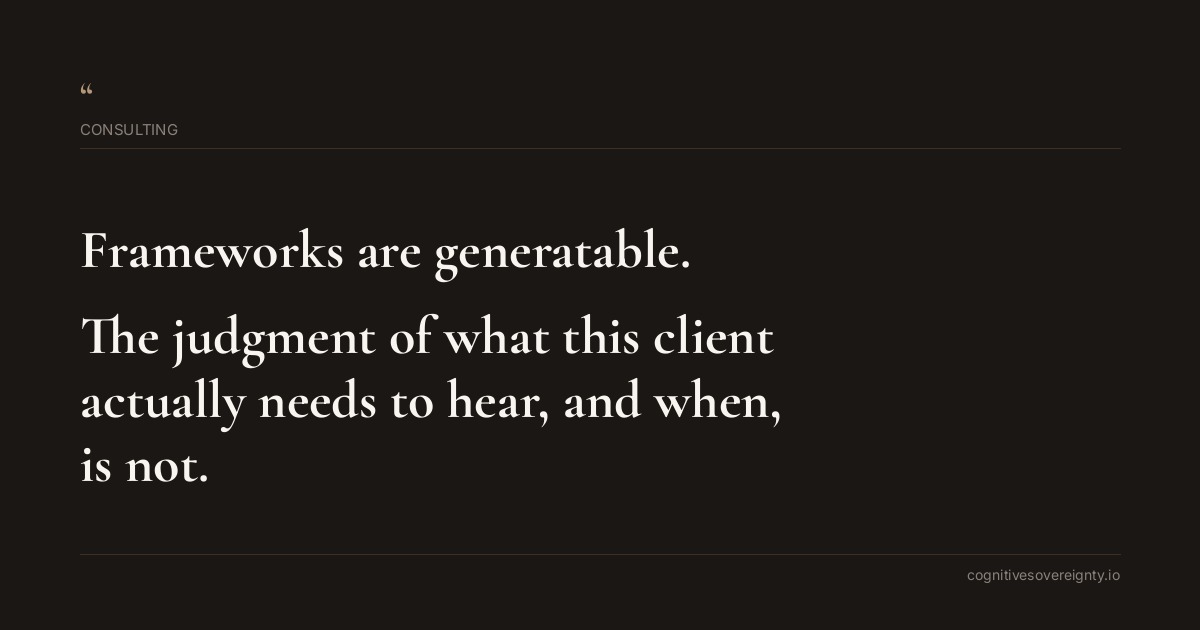
Your clients can now access the same analytical tools your junior consultants use to build foundational analysis. The cognitive risk is real: your firm becomes a formatting service for AI outputs rather than a source of independent judgement. Without deliberate protection, the insights that change how clients think will disappear first.
Tool names in this checklist are examples. If you use different software, the same principle applies. Check what is relevant to your workflow, mark what is not applicable, and ignore the rest.
These are suggestions. Take what fits, leave the rest.
Tap once to check, again to mark N/A, again to reset.
Protect Your Independent Perspective
Audit which analyses your clients could run themselves with ChatGPT or Claudebeginner
List the work your team bills for. Test how much of it a client could produce by typing a prompt into a public AI tool. This is your vulnerability map. The analyses that sit here are your first candidates for commoditisation.
Define the specific client context your analysis adds beyond what AI generatesintermediate
When your consultant recommends action B instead of action A, what client-specific knowledge drives that choice? Name it explicitly. If the answer is 'our template is better', you have a problem.
Require your team to challenge AI outputs before using them in client workbeginner
Create a rule: no analysis from Copilot, ChatGPT or Claude goes into a client deliverable without a senior consultant first finding a flaw in it. This protects the habit of independent thinking and often surfaces real vulnerabilities in the AI output.
Document the reasoning behind client recommendations separately from the supporting analysisintermediate
Your junior consultants build judgement by learning why you chose option B. If the recommendation emerges from AI analysis without explicit reasoning attached, that learning stops and your next generation loses the chance to develop independent perspective.
Schedule time to disagree with what the AI tools produceintermediate
Set aside project time for your team to find points where the AI consensus is incomplete or wrong for this client. These disagreements often become your most valuable recommendations.
Protect the hypothesis phase before you use AI for analysisbeginner
Ask consultants to write down what they expect to find before they prompt an AI tool. This forces independent thinking first and makes it obvious when the AI output simply confirms what the tool was designed to predict.
Build a library of past recommendations that proved valuable and trace whyadvanced
When you gave advice that actually changed client behaviour months later, why did it work? Compare these cases to the generic advice AI tools produce. The gap is where your real judgement lives.
Rebuild Value Around Judgement, Not Analysis
Stop selling analysis hours and start selling decisions the client needs to makeadvanced
Your current fee structure charges for the work that AI now does. Shift the conversation to what choice matters most to the client and what they need to decide. Price the decision support, not the analysis that leads to it.
Identify which client relationships depend on your independent view rather than your dataintermediate
Which clients call you because they trust your judgement, not because you have better data? These relationships are safer from commoditisation. Strengthen them by showing your thinking process, not just your conclusions.
Record how your advice differs from what a generic AI tool would recommend in each engagementintermediate
After the project ends, run the same brief through ChatGPT or Claude. Where did your consultant recommend something different? That difference is the only thing your client actually paid for.
Create a point of view on your client's industry that goes beyond what AI consensus producesadvanced
AI tools are trained on published information. Your consultants have conversations, attend industry events and see patterns clients don't. Build a specific, written perspective on what is about to matter. This is defensible intellectual property.
Ask each client what question matters most to them that they haven't solvedbeginner
This question matters more than the brief. Clients can now generate answers to their standard questions with AI tools. Your value is helping them ask the questions they haven't formulated yet.
Charge explicitly for the risk your judgement absorbs on their behalfadvanced
When your consultant recommends a path the data doesn't fully support, they are taking a judgement risk. Name that risk in your proposal. This is not a reduction in scope. It is the core of your value.
Govern How Your Team Develops Judgement
Restrict which AI tools your junior consultants can use for foundational analysisbeginner
If your graduate hires begin with ChatGPT instead of building their own analysis, they never develop the pattern recognition that becomes judgement. Some analytical work should stay manual during the learning years.
Create a review process where senior consultants explain why they changed a junior's AI-generated analysisintermediate
This is how juniors learn. If a senior consultant receives AI output from a junior and modifies it without explaining the reasoning, the development stops. Make the critique explicit and documented.
Require your team to present client recommendations before showing the analysis that supports thembeginner
This forces your team to own the recommendation independently. If they cannot defend their view without the data, they haven't developed real judgement yet.
Build a feedback loop where client outcomes are traced back to your consultant's original reasoningintermediate
Did the recommendation work? Why or why not? This is the only way your team learns whether their judgement is sound. AI tools cannot provide this feedback because they have no stake in the outcome.
Pair junior consultants with senior ones specifically to watch how they challenge their own conclusionsbeginner
Your experienced consultants have developed scepticism about their own thinking. This is what junior consultants need to learn. Make this practice deliberate, not accidental.
Document the analytical dead ends your team encounters so they see how judgement formsintermediate
When analysis leads nowhere, that teaches discernment. If your team only sees the analyses that worked, they have no reference for how to recognise a weak line of thinking.
Five things worth remembering
- The analyses your clients can now run themselves are exactly the work that built your junior consultants' judgement. Find new ways to develop their thinking or they will leave when they realise they are not learning.
- Your most vulnerable client relationships are ones where the client hired you for analytical output. Shift these toward advisory relationships quickly. The others will follow.
- When an AI tool produces an output that looks polished, this is most dangerous. Poor analysis is easy to spot and challenge. Plausible-sounding generic advice is what commoditises your firm.
- The provocative insight that changes client behaviour is now your scarcest asset. Protect the time and autonomy your best consultants need to develop these insights instead of chasing utilisation rates.
- If your firm measures success by reducing the time analysts spend on foundational work, you are accelerating your own commoditisation. Time saved is not value created when clients can now access the same analysis directly.
Common questions
Should consulting and professional servicess audit which analyses your clients could run themselves with chatgpt or claude?
List the work your team bills for. Test how much of it a client could produce by typing a prompt into a public AI tool. This is your vulnerability map. The analyses that sit here are your first candidates for commoditisation.
Should consulting and professional servicess define the specific client context your analysis adds beyond what ai generates?
When your consultant recommends action B instead of action A, what client-specific knowledge drives that choice? Name it explicitly. If the answer is 'our template is better', you have a problem.
Should consulting and professional servicess require your team to challenge ai outputs before using them in client work?
Create a rule: no analysis from Copilot, ChatGPT or Claude goes into a client deliverable without a senior consultant first finding a flaw in it. This protects the habit of independent thinking and often surfaces real vulnerabilities in the AI output.