For Marketing Managers
Cognitive Sovereignty Checklist for Marketing Managers
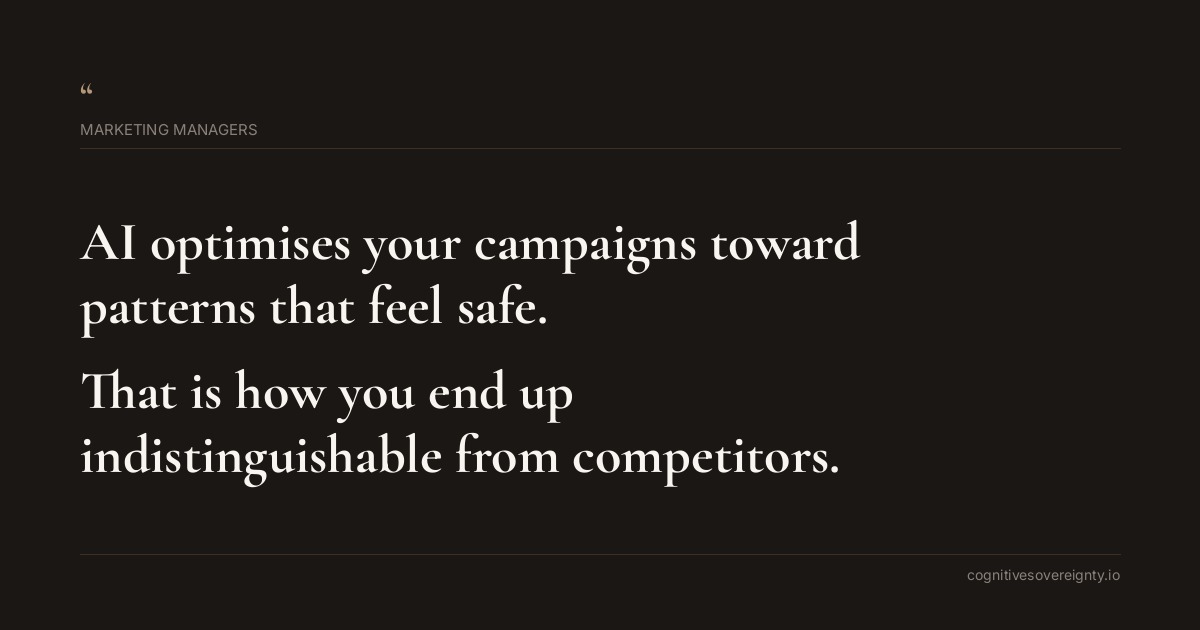
Your AI tools measure what converts in the short term, not what builds your brand in the long term. HubSpot, ChatGPT, and Performance Max will optimise your campaigns toward engagement patterns that feel safe and proven, pushing you away from the distinctive work that made your organisation recognisable. This checklist helps you stay in control of your marketing judgement.
These are suggestions. Take what fits, leave the rest.
Tap once to check, again to mark N/A, again to reset.
Protect Your Brand Strategy From Algorithmic Drift
Keep Your Audience Understanding Human-Led
Defend Your Creative Craft Against Algorithmic Homogenisation
Five things worth remembering
- Before you accept any AI campaign recommendation, ask yourself: would my competitor make the same choice? If yes, send it back. Your margin comes from being different, not from being optimised the same way everyone else is.
- Your best campaign insight is usually something you noticed that no metric captured. A customer mentioned in passing that they use your product differently than you marketed it. Keep a notebook for these moments. They are worth more than any audience segment Performance Max will ever find.
- Claude and ChatGPT are excellent at making ideas clearer and faster to execute. They are terrible at making ideas more distinctive. Do the hard thinking work yourself, then hand the tool a finished direction to refine.
- Set one metric that no AI tool controls. Maybe it is the number of customers who cite a specific brand attribute as their reason for buying. Maybe it is the number of times your creative gets shared without being asked to. Pick something that measures what you care about, not what the algorithm can optimise.
- Every three months, ask your creative team what they miss about work before AI tools existed. Their answer will tell you what skills are disappearing and what part of your marketing judgement you need to protect most fiercely.
Related reads
Prompt Pack
Paste any of these into Claude or ChatGPT to pressure-test your own judgment. They work best when you respond honestly before reading the AI reply.
Test your customer insight before AI research
I am developing a campaign for [product/brand/audience]. Before I run any AI analysis or check any data dashboards, ask me questions about what I genuinely know about this customer from direct contact and observation. What do I know that no dataset captures?
Find the contrarian angle AI analysis missed
I have done AI-assisted market and audience research for [campaign/project]. Now act as a sharp strategist: what angles, tensions, or customer truths is AI-trained-on-existing-content almost certainly going to miss or flatten out? Where is the non-consensus insight in this market?
Pressure-test a strategic recommendation
I am about to recommend [describe strategy or campaign approach]. Challenge me: what assumptions am I making that I have not directly tested? What is the strongest argument against this approach from someone who actually knows this customer segment?
Write your own creative brief first
I need to write a brief for [describe project]. Before I use any AI tools to help structure it, ask me questions about the customer, the problem we are solving, the insight behind the brief, and what success looks like. I want my thinking to drive the brief, not the AI template.
Audit your strategic thinking habits
I want to examine how much of my current strategic thinking is genuinely mine versus shaped by AI analysis I have absorbed and treated as insight. Ask me about a recent strategic recommendation, who had the key ideas, where they came from, and what direct evidence they were based on.
Reading List
Five books that give this topic the depth it deserves. Each one is genuinely worth reading, not just citing.
Thinking, Fast and Slow
Understanding how customers actually make decisions is the foundation of effective marketing. And it is very different from how AI models assume they do.
Ogilvy on Advertising
The case for deep customer research and honest, evidence-based creative work, written before AI existed and more relevant to the current moment than most marketing books published this decade.
Alchemy
The most compelling argument for why the counterintuitive, psychologically complex insights that drive real marketing effectiveness are exactly what data optimisation, including AI, systematically misses.
Stolen Focus
Understanding what is happening to audience attention. The actual human experience AI marketing tools are trying to reach, is essential context for any marketer.
Cognitive Sovereignty
A framework for protecting the strategic and creative judgment that makes marketing distinctive, as AI tools push every campaign toward the consensus middle.
Questions to ask yourself
Use these before your next AI-assisted decision. Honest answers are more useful than comfortable ones.
- When did I last develop a strategic or creative insight that came from direct customer contact rather than AI analysis?
- Is my instinct for what will actually resonate with customers getting stronger or weaker?
- What do I know about the audience for my current campaign that no AI analysis or data dashboard captures?
- Am I using AI to go faster on work I already understand, or to avoid doing the harder thinking myself?
- If I described my best strategic insight this year, how much of it was genuinely mine?
Common questions
How should marketers use AI tools without losing their strategic edge?
Use AI for the work that requires volume and speed: generating copy variants for testing, processing customer data at scale, building creative briefs. Protect the work that requires real market understanding: identifying which customer insight matters, reading the emotional truth in research, and making the creative judgment calls that separate memorable campaigns from forgettable ones. The more of the second type you delegate, the less distinctive your thinking becomes.
Will AI replace marketing professionals?
AI is already replacing the execution layer of marketing, templated copy, basic segmentation, scheduled social content. The roles at risk are the ones that were always thin on genuine strategic thinking. Marketers who can develop deep customer insight, challenge briefs, and make creative decisions grounded in genuine market understanding are not at risk. Those who primarily process and execute are.
Can AI understand customers better than marketers?
AI can process more data faster and surface patterns that humans would miss. But understanding why customers behave the way they do. The emotional context, the unspoken need, the cultural moment, requires the kind of interpretive judgment that comes from direct human contact with customers. AI analysis tells you what is happening; human insight tells you what it means.
What are the risks of using AI for brand strategy?
Brand strategy built on AI analysis of existing market data tends toward consensus: it reflects what audiences have responded to before rather than what they do not yet know they want. The most distinctive brands are built on a contrarian insight that data analysis would not have surfaced. When AI shapes brand strategy too heavily, you get safe, derivative positioning.
How can marketers build genuine customer insight in an AI-heavy workflow?
By maintaining direct customer contact that sits outside the AI analysis loop: customer interviews that are not summarised by AI, ethnographic observation, genuine immersion in the customer's world. AI insight is built from what customers have already done and said. Human insight can access what they have not yet articulated.