For Teacherss and Educators
Cognitive Sovereignty Checklist for Teacherss
When you use ChatGPT to plan lessons or Khanmigo to support students, the work feels faster and smarter. The danger is real. You might stop trusting your own read of a room, and students might submit polished work that hides shallow thinking. Both of those are harder to reverse than the time you saved.
These are suggestions. Take what fits, leave the rest.
Tap once to check, again to mark N/A, again to reset.
Recognise When AI Is Replacing Your Classroom Judgement
Design Assessment That Forces Real Understanding Into View
Reclaim the Craft of Teaching From AI Efficiency
Five things worth remembering
- When an AI tool offers to mark work or generate feedback, sit with one piece of student work and mark it yourself first. Compare your feedback to what the AI gave. You will see what matters that the tool missed.
- Ask your students: Show me one thing an AI tool helped you with this week, and one thing you figured out yourself. This simple question makes them notice the difference between help and outsourcing their thinking.
- Set a rule: You must understand a student's confusion before you can explain it away. If you skip this step and jump to an AI explanation, you have stopped teaching.
- Use AI for the work you hate, not the work you love. Use it for marking 200 multiple choice responses, not for designing your Year 9 poetry unit. Protect the parts of teaching that are craft.
- Every term, teach one lesson the way you would have taught it ten years ago, with no AI. Notice what you miss. Notice what is better. Let the comparison guide where AI belongs in your practice.
Prompt Pack
Paste any of these into Claude or ChatGPT to pressure-test your own judgment. They work best when you respond honestly before reading the AI reply.
Test your own lesson design thinking
I am planning a lesson on [topic] for [year group / age]. Before I look at any AI-generated plans, ask me questions about what my specific students need, where they typically get stuck, and what I am trying to achieve. Then I will compare my thinking to an AI plan.
Audit your feedback habits
I have been using AI to help write feedback on student work. Ask me questions that help me examine whether this feedback genuinely reflects my knowledge of these students or whether it has become generic. What have I stopped noticing since I started using AI for this?
Design an AI-proof assignment
I need to redesign an assignment that students are currently completing using AI without learning anything. The topic is [describe]. Help me redesign it so that the learning process, not just the output, is what gets assessed.
Rebuild your reading of student understanding
Describe a student response or piece of work and ask me what I think it reveals about their understanding, before I see any AI analysis. Help me practice making my own diagnostic judgments about student learning.
Challenge your reliance on AI curriculum resources
I have been using AI-generated materials in my classroom. Ask me how much of my current curriculum planning reflects genuine pedagogical decisions versus convenient AI defaults. What have I stopped thinking about carefully since I started using these tools?
Reading List
Five books that give this topic the depth it deserves. Each one is genuinely worth reading, not just citing.
Make It Stick
The science of how learning actually works, retrieval, spacing, interleaving, desirable difficulty. Every principle here is undermined by students using AI to skip the struggle.
Why Don't Students Like School?
A cognitive scientist's account of how memory and thinking work in learning. The implications for AI-assisted education are significant and under-discussed.
The Shallows
What persistent use of tools that do the thinking for us does to the capacity for sustained reading and deep thought. The foundation of education.
Range
The case for breadth and transferable thinking over narrow specialisation, a direct counter to AI systems that optimise for narrow task performance.
Cognitive Sovereignty
A framework for protecting independent thought that is directly applicable to what you want your students to develop. And what AI is quietly dismantling.
Questions to ask yourself
Use these before your next AI-assisted decision. Honest answers are more useful than comfortable ones.
- When did I last design a lesson from scratch based on my knowledge of these specific students, without starting from an AI-generated plan?
- Is my feedback on student work genuinely individual, or has it become generic since I started using AI assistance?
- Am I building my pedagogical judgment over time, or delegating decisions I should be making myself?
- What do I know about my students that no AI curriculum tool has access to. And am I acting on it?
- Are my students developing the capacity to think through difficulty, or am I enabling them to avoid it?
Common questions
Should teachers use AI tools in the classroom?
AI tools can reduce the administrative burden of teaching, generating differentiated resources, writing feedback on drafts, and helping plan lesson sequences. The question is whether using AI for these tasks comes at the cost of the pedagogical thinking that makes you an effective teacher. Lesson design built on your knowledge of your specific students is different from AI-generated lesson design built on generic learner profiles.
How can teachers tell if students are using AI on their work?
Detection tools exist but are unreliable and produce false positives. More effective approaches involve assignment design that makes AI-generated responses obviously inadequate: in-class discussion of submitted work, oral components, assignments that require personal experience, and iterative drafts. These also happen to be better learning designs regardless of AI.
What are the risks of AI for education?
The deepest risk is not cheating. It is the erosion of the productive struggle that builds genuine competence. When students bypass the difficulty of formulating their own ideas, constructing arguments, and working through confusion, they do not develop the cognitive capability that education is meant to build. AI makes the output easy and hollows out the process.
Will AI replace teachers?
AI can personalise content delivery and provide instant feedback at scale, which are parts of teaching. But the relational work of education, reading where a student is emotionally, knowing when to challenge and when to support, building the trust that makes learning possible, is not a content delivery problem. Those skills are not at risk of automation; they are at risk of neglect if teachers over-delegate to AI.
How should teachers respond to students using AI?
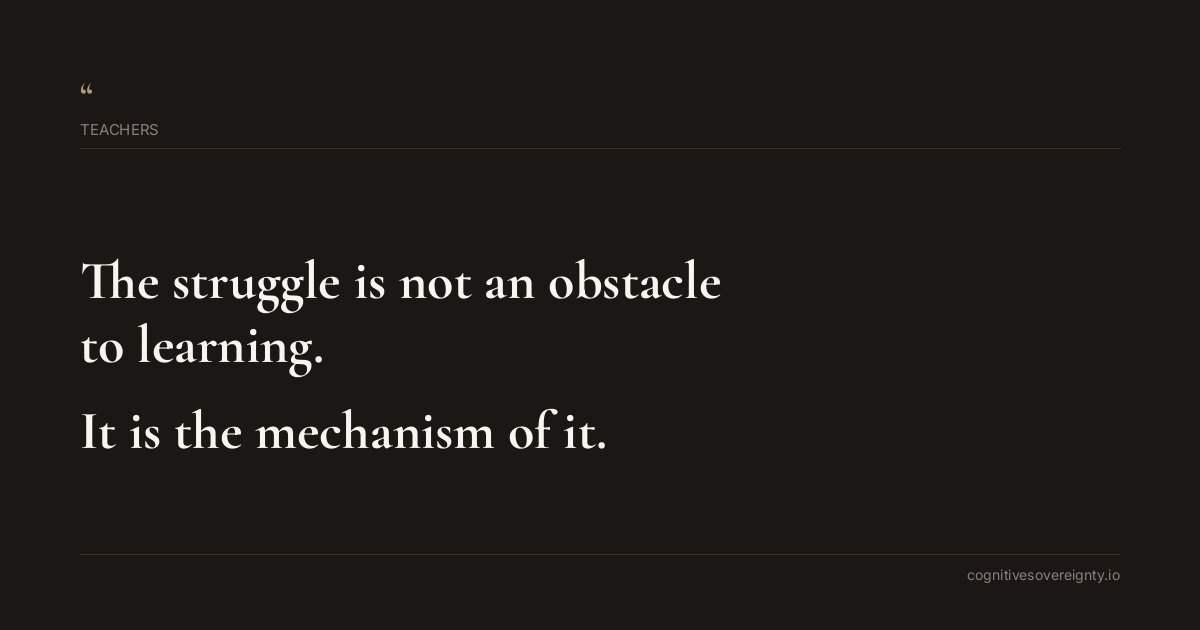
Treat it as a curriculum question rather than a discipline problem. Help students understand what AI does to their learning process, that the struggle is not an obstacle to learning, it is the mechanism of it. Build assignments that require students to demonstrate understanding through dialogue, reflection, and application rather than just finished text.