By Steve Raju
For Video Producers
Cognitive Sovereignty Checklist for Video Producers
About 20 minutes
Last reviewed March 2026
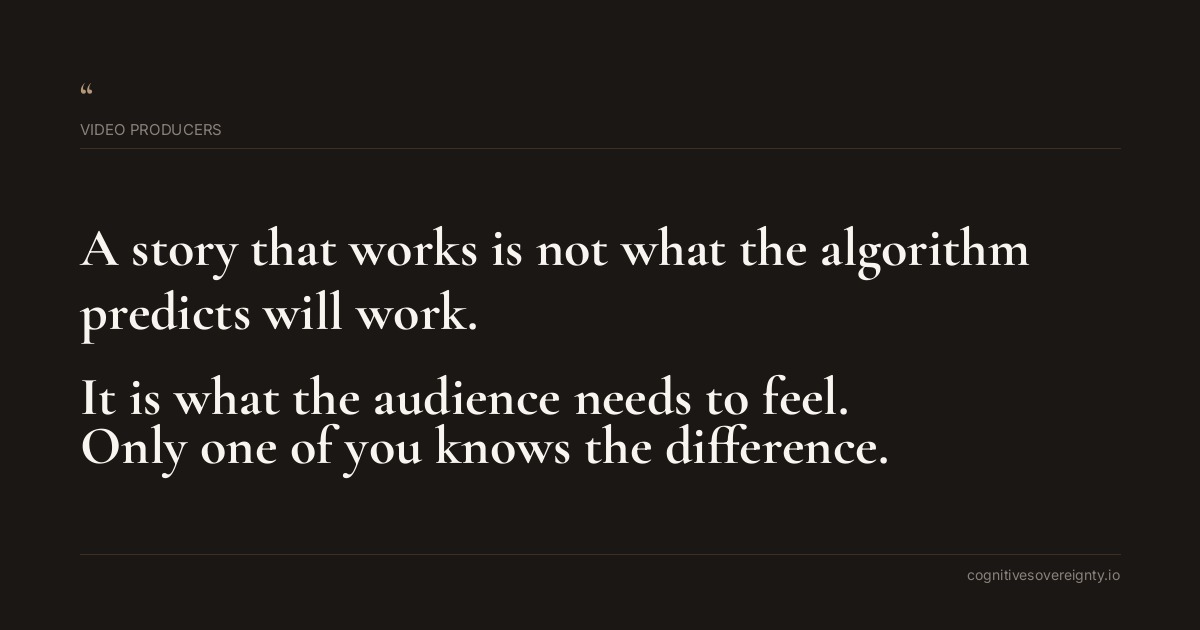
AI scriptwriting tools produce grammatically sound dialogue that audiences stop watching halfway through. Editing assistants optimise for average watch time rather than the story you intended to tell. Without deliberate practice, the producer instinct that knew which shot worked and why becomes a skill you no longer possess.
Tool names in this checklist are examples. If you use different software, the same principle applies. Check what is relevant to your workflow, mark what is not applicable, and ignore the rest.
These are suggestions. Take what fits, leave the rest.
Tap once to check, again to mark N/A, again to reset.
Protect Your Storytelling Judgement Before AI Rewrites It
Write your own story outline before asking AI to generate a scriptbeginner
Hand-write a three-beat structure showing what happens, why it matters, and what changes. This forces you to recognise the emotional shape of your story before AI flattens it into information delivery.
Reject the AI script's first draft automaticallybeginner
Every ChatGPT or Descript output will feel functional. Read it once, then rewrite at least one third from memory of what you actually wanted to say. This prevents the script from becoming the default version in your head.
Identify three moments in your script where AI optimised for clarity over tensionintermediate
AI tends to explain things twice and remove pauses. Mark places where the audience should sit with confusion or uncertainty. Rewrite these sections to preserve the reveal, not rush to resolution.
Record a voiceover performance without AI voice generation at least once per quarterintermediate
ElevenLabs and similar tools make your own voice sound robotic by comparison. Record yourself to remember what a human breath, hesitation, and emphasis actually do to storytelling. You will hear what the AI version removed.
Document why you rejected each AI-suggested edit in a production logadvanced
When Adobe Premiere AI suggests a cut, write one sentence about why you kept the longer take instead. This creates a record of your editorial logic so you can recognise if you stop having reasons.
Watch three films in your genre without checking your phone and note one editing choice that surprised youintermediate
Your storytelling instinct comes from internalising how others tell stories. AI trains on what already exists. Watching attentively builds judgement about what comes next.
Resist Convergence Toward AI-Optimal Format
Set a content strategy before opening any AI toolbeginner
Write down who your actual audience is, what they already know, and what action you want them to take. AI will optimise for watch time across average viewers. You need to optimise for your specific person's behaviour change.
Compare your last five videos to the YouTube algorithm recommendations next to thembeginner
Notice whether your thumbnails, pacing, and hooks match the AI-suggested content. If they do, you are making algorithm content, not your content. Deliberately choose one element that differs.
Require AI tools to show you three alternative edits before accepting their first suggestionintermediate
RunwayML and Descript will highlight only the most engagement-optimised cut. Demand alternative structures so you can see what the algorithm considers less optimal but you consider more true to intent.
Mark one scene per project as non-negotiable creative choice before editing startsbeginner
Identify a shot, sequence, or pacing decision that matters to your vision more than watch time. Tell your editing AI it is off limits. This forces you to maintain intentionality outside algorithmic logic.
Analyse three videos from producers you respect and identify what makes them different from algorithm-optimal contentintermediate
Look for longer takes, slower pacing, or unconventional structure. Write down whether these choices serve the story or reject engagement metrics. This clarifies what you actually value about video production.
Keep a production notebook where you sketch shots before showing them to AI assembly toolsadvanced
Draw rough storyboards or write descriptions of how scenes should connect. This separates your visual thinking from AI suggestions early enough that you still have a competing vision.
Calculate the engagement difference between an algorithmic cut and your original editorial choiceadvanced
When you override AI suggestions, measure whether you lost watch time and gained something else. Data about your specific audience matters more than general optimisation rules.
Maintain Producer Judgement Through Active Practice
Make at least one micro-cut per month without consulting AI suggestions firstbeginner
Edit a 30 second sequence using only your own judgment about pacing, shot selection, and transitions. You will notice immediately what instincts you have lost and which ones stayed active.
Review your own production choices from videos made before you used AI toolsintermediate
Watch cuts, shot selections, and pacing decisions you made without AI help. Write down three editing choices you would never have made if the algorithm had suggested first. Practise making those choices again.
Defend every AI-suggested edit by explaining it to a non-technical peer before including itbeginner
If you cannot explain why an algorithmic cut works to someone outside production, it probably works for optimisation, not storytelling. Explanation forces you to separate real reasoning from default acceptance.
Shoot coverage for each scene that gives you at least two genuine editing choicesintermediate
Over-reliance on AI happens when you have only one good take. Capture alternatives so your assembly cut reflects your choice, not AI picking from limited options.
Create a production brief that specifically outlines what AI should not touchbeginner
Before handing footage to RunwayML or Premiere, write three to five editorial principles that are off limits to automation. Name the specific creative decisions that belong to you, not the algorithm.
Spend one day per project on audio design choices before AI voiceover and music tools touch the mixintermediate
ElevenLabs and similar tools make audio feel polished and neutral. Hand-sculpt sound before automation so you know what qualities you chose and which ones got smoothed away.
Teach another producer one production decision you made that contradicted AI suggestionsadvanced
Articulating your own judgement to someone else forces clarity about what you actually know versus what you defaulted to. Teaching locks in your instinct.
Five things worth remembering
- Before AI generates anything, write your story intention in one sentence. When the output arrives, compare it to that sentence. If they match, the AI understood you. If they do not, you learned what got lost in translation.
- Every time you accept an AI-suggested edit, ask: would I have chosen this if the algorithm had not pointed it out? Honest answers show you whether AI is assisting your judgment or replacing it.
- Keep a separate edit timeline where you make cuts without consulting AI recommendations. Compare it to the AI-optimised version when you are finished. Differences reveal your actual creative voice.
- Your producers' instinct came from watching audiences. AI trains on data. Watch real people engage with your videos in person at least once per quarter. No algorithm replaces that feedback.
- Mark one production element per project as yours alone: the opening shot, the pacing of a reveal, the final image. Protect it fiercely from automation. That single choice keeps you a creator, not a reviewer.
Common questions
Should video producers write your own story outline before asking ai to generate a script?
Hand-write a three-beat structure showing what happens, why it matters, and what changes. This forces you to recognise the emotional shape of your story before AI flattens it into information delivery.
Should video producers reject the ai script's first draft automatically?
Every ChatGPT or Descript output will feel functional. Read it once, then rewrite at least one third from memory of what you actually wanted to say. This prevents the script from becoming the default version in your head.
Should video producers identify three moments in your script where ai optimised for clarity over tension?
AI tends to explain things twice and remove pauses. Mark places where the audience should sit with confusion or uncertainty. Rewrite these sections to preserve the reveal, not rush to resolution.