By Steve Raju
For Business Development
Cognitive Sovereignty Checklist for Business Development Managers
About 20 minutes
Last reviewed March 2026
AI prospect research tools compile data fast, but they miss the relationship context that actually opens doors. When you rely on AI to assess which opportunities are worth your time, your instinct for real deals weakens. This checklist helps you stay in control of your commercial judgment.
Tool names in this checklist are examples. If you use different software, the same principle applies. Check what is relevant to your workflow, mark what is not applicable, and ignore the rest.
These are suggestions. Take what fits, leave the rest.
Tap once to check, again to mark N/A, again to reset.
Prospect Research: Keep Your Relationship Map Intact
Read the company website before reading AI summariesbeginner
AI tools like Apollo.io and LinkedIn Sales Navigator generate prospect profiles from public data. Your own reading of their website, recent news, and investor announcements forms the baseline you need to spot what AI missed. You develop pattern recognition this way.
Check LinkedIn for the actual decision-maker, not the title matchbeginner
AI flags job titles that fit your target criteria. The real person who moves deals often has a different title or sits in a different function than the algorithm expects. Your network knowledge tells you who actually influences buying decisions at that organisation.
Ask three colleagues if they know someone at the prospect companyintermediate
Warm introductions open doors. AI prospect research cannot see your personal network or your colleagues' networks. A five-minute conversation with a peer often reveals a direct path to the right contact that no AI tool can surface.
Identify the relationship reason before you run a data searchintermediate
Before you open Perplexity or ChatGPT, ask yourself why this company matters to you right now. Is there a product release? A funding round? A leadership change? Start with the business reason, then use AI to fill in facts. This reversal keeps your judgment first.
Verify any AI claim about a recent company milestoneintermediate
AI training data has cutoff dates and gaps. If an AI tool tells you a prospect hired a new VP or closed funding, check the company's newsroom or press releases yourself. False leads waste your time and damage credibility when you reference inaccurate details.
Note what AI research missed, then spot the patternadvanced
Keep a running list of what ChatGPT or Apollo.io overlooked about prospects you already knew well. After three or four examples, you see the blind spots. This teaches you exactly when to trust AI and when to override it.
Set a rule for when you will not use AI prospect research at alladvanced
For opportunities under a certain deal size, or in sectors where relationships matter most, skip the AI tool and rely on your network. This boundary keeps your instinct sharp in the deals that matter most.
Outreach and Engagement: Preserve Your Voice
Write your first draft without AI assistancebeginner
You have written hundreds of outreach emails. Your voice carries the credibility that converts. Use ChatGPT to edit or refine, not to generate. AI first drafts sound professional and impersonal. Your instinct for what resonates with this prospect is more valuable.
Include one fact about the prospect that only you could knowbeginner
Before you send any outreach sequence generated by AI, add one detail that shows you read their recent earnings call, attended their event, or know someone they work with. This single sentence signals genuine research and breaks through the impersonal tone that sinks AI-written messages.
Reject any AI-generated subject line that uses a question markbeginner
Questions in subject lines feel generic at scale. They work when you have one relationship context. When you are sending the same sequence to fifty prospects, those question marks read as a template. Write subject lines that reference something specific to their business instead.
Test AI copy against your best-performing emails from the pastintermediate
Pull three of your highest-response outreach emails from the last year. Compare them to the copy ChatGPT or Apollo.io generated for the same prospect type. What is different? What did AI remove? This comparison keeps you calibrated on what actually works.
Set a response threshold before you send the sequenceintermediate
Decide in advance what response rate would tell you the AI-generated sequence is not working. At fifteen percent response, you pivot. This rule stops you from running six or seven rounds of a weak sequence because it came from a trusted tool.
Personalise the middle of the sequence by handadvanced
Use AI to generate the sequence structure and opening. Then write three middle-of-sequence emails yourself. These are where relationship context comes in. Your follow-up that references their specific situation converts better than a generic sequence.
Opportunity Assessment: Trust Your Deal Instinct
Identify one signal that AI cannot see before you assess the opportunitybeginner
Before you run Salesforce Einstein analytics or ask ChatGPT to score the opportunity, ask a peer who knows the prospect: Is the timing right? Is there budget? Is there internal support? AI sees financial data and firmographics. It misses the political and timing signals that make a deal close.
Compare the AI score to your instinct scorebeginner
Rate the opportunity yourself first, without AI input. Write down a number between one and ten. Then look at what Salesforce Einstein or ChatGPT says. If they disagree by three points or more, investigate why. Your years of deal-making carry real signal.
Ask the prospect one question that reveals priorityintermediate
AI assessment tools rank opportunities by fit and intent signals. They cannot hear hesitation or urgency in a conversation. Call the prospect and ask them a single question that forces them to reveal whether this is a priority right now. Their answer tells you more than any AI model.
List three reasons AI ranked this opportunity differently than you didintermediate
When your judgment and the AI score diverge, write down three specific reasons. Are you seeing a relationship barrier that the algorithm missed? Are you hearing budget constraints in a way the data does not show? Understanding the gap strengthens your judgment.
Walk the opportunity past someone who lost a similar dealintermediate
Find a colleague who worked this type of prospect and lost. Ask them what went wrong. Their experience is not in the database. It is not in the AI training data. It is in their judgment, and it teaches you faster than any model.
Decide which stage gate you will not automateadvanced
Identify one critical assessment moment in your pipeline where you always make the call yourself, without AI input. For most business development managers, this is the decision to invest serious time in a prospect. Keep that gate human.
Five things worth remembering
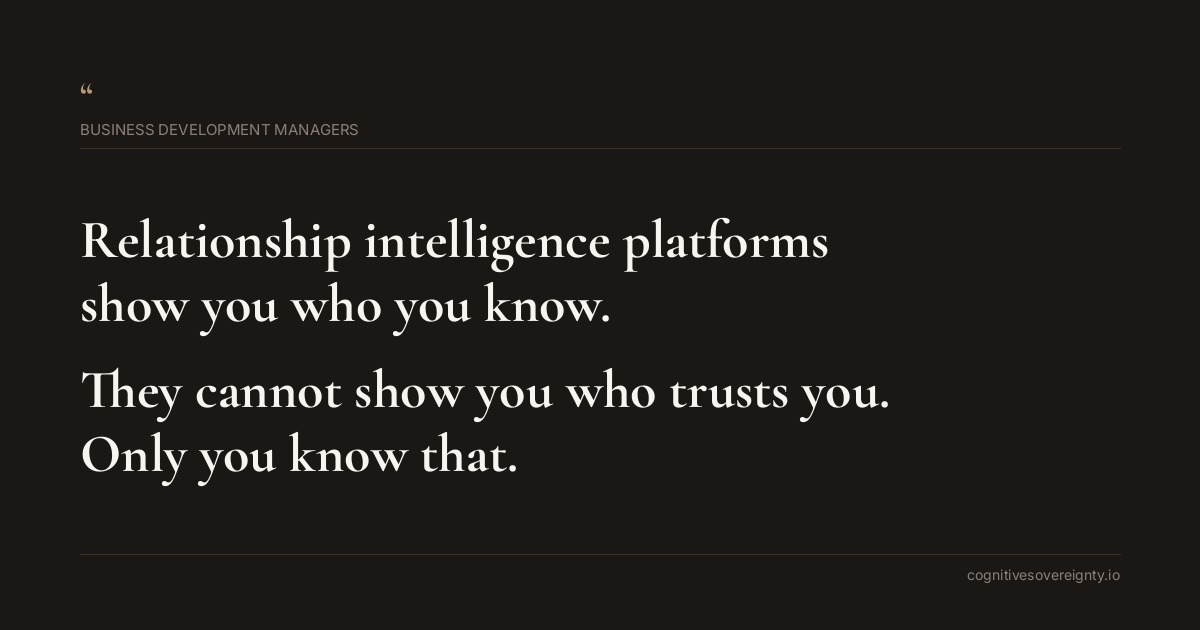
- Your network is your competitive advantage. AI tools see everyone's data. They see no one's relationships. Spend fifteen minutes on the phone with a peer who knows the prospect. That beats thirty minutes of AI research.
- When AI outreach converts at five percent but your personal emails convert at twelve percent, the difference is your voice. Do not let efficiency arguments erode it.
- Track opportunities you walked away from based on your instinct, then find out whether they closed with someone else. This teaches you when your judgment is right and when the AI algorithm was smarter.
- The worst outcome is not a bad AI recommendation. It is that you stop forming your own recommendations altogether. Use AI to work faster, not to think for you.
- Every time you override an AI score and you are right, write it down. After twenty examples, you see your pattern. That pattern is your deal intelligence. Protect it.
Common questions
Should business development managers read the company website before reading ai summaries?
AI tools like Apollo.io and LinkedIn Sales Navigator generate prospect profiles from public data. Your own reading of their website, recent news, and investor announcements forms the baseline you need to spot what AI missed. You develop pattern recognition this way.
Should business development managers check linkedin for the actual decision-maker, not the title match?
AI flags job titles that fit your target criteria. The real person who moves deals often has a different title or sits in a different function than the algorithm expects. Your network knowledge tells you who actually influences buying decisions at that organisation.
Should business development managers ask three colleagues if they know someone at the prospect company?
Warm introductions open doors. AI prospect research cannot see your personal network or your colleagues' networks. A five-minute conversation with a peer often reveals a direct path to the right contact that no AI tool can surface.