By Steve Raju
For Healthcare Administratorss
Cognitive Sovereignty Checklist for Healthcare Administrators
About 20 minutes
Last reviewed March 2026
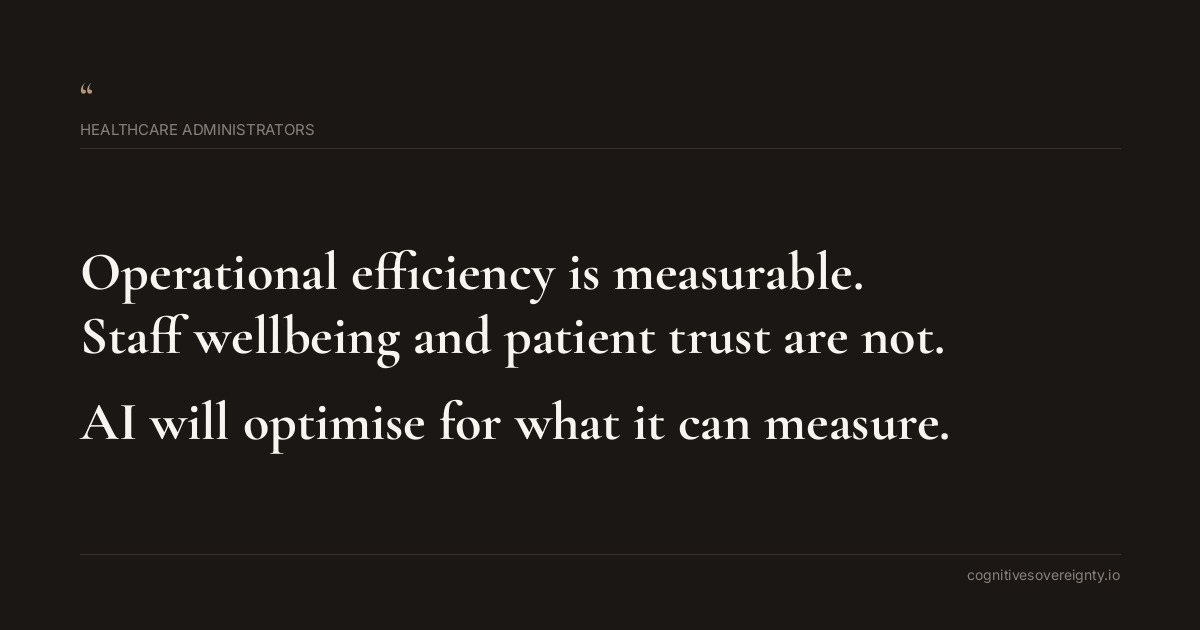
You face a specific cognitive trap. AI tools like Epic AI and Cerner AI excel at measuring and optimising the metrics you can see: throughput, labour costs, scheduling efficiency. They make those numbers improve reliably. What they cannot measure is the clinical wisdom your staff lose when they stop making independent decisions. Your judgement as an administrator gets clouded because the AI results look objectively good on the dashboard.
Tool names in this checklist are examples. If you use different software, the same principle applies. Check what is relevant to your workflow, mark what is not applicable, and ignore the rest.
These are suggestions. Take what fits, leave the rest.
Tap once to check, again to mark N/A, again to reset.
Before You Buy or Implement AI Tools
Demand a clinical safety assessment separate from the vendor's cost-benefit analysisbeginner
Vendors like IBM Watson Health and Google Health AI present savings projections. These projections ignore the cost of clinical staff deskilling and the time clinicians spend overriding or mistrusting AI decisions. Ask your chief medical officer and senior nurses to assess whether the tool changes clinical judgement behaviour before implementation.
Identify which operational decisions the AI will replace versus supportbeginner
Some decisions in your hospital are safety-critical. Patient triage, bed allocation involving complex medical needs, and discharge timing all require clinical context that AI tools often miss. Write down which specific decisions Epic or Cerner AI will take over. If clinicians cannot easily override those decisions, you have a governance problem.
Create a procurement checklist that requires clinical team sign-off before budget approvalintermediate
Budget decisions for AI implementation often move through finance and operations without input from the clinical staff who will use the tools daily. Require written sign-off from head of nursing, medical director, and patient safety lead before any AI system enters your procurement process. This prevents vendors from being chosen based solely on efficiency gains.
Test the AI tool in a controlled setting with real patient data and real time pressureintermediate
Vendors demonstrate their tools in ideal conditions. Your emergency department at 11pm on a Saturday is not ideal. Run a six to eight week pilot where clinicians use the AI tool alongside their normal judgement. Measure not just efficiency but also how often clinicians question or override the tool.
Map which staff roles currently hold operational knowledge that the AI will absorbadvanced
Your experienced bed managers, senior nurses, and department heads carry tacit knowledge about patient flow that they did not learn from a handbook. Before AI takes over scheduling or triage, document what that knowledge is. This prevents the knowledge from vanishing when the person retires.
Negotiate contractual limits on how AI decisions can be implemented without human reviewadvanced
Some vendor agreements allow the AI system to execute decisions (like bed assignment or staffing allocation) without requiring staff approval. Insist that safety-critical decisions remain supervised. Your contract should specify which decisions require a clinician or manager to confirm before the system acts.
While the AI Tool is Running in Your Organisation
Track override rates and reasons clinicians reject AI recommendationsbeginner
If nurses are overriding the AI's triage decisions 30 percent of the time, something important is happening. Your staff are recognising situations the tool misses. High override rates are not a sign of failure. They are a sign that your clinicians still have independent judgement. Monitor these patterns monthly, not annually.
Measure patient experience scores and clinical safety indicators separately from efficiency metricsbeginner
Your dashboard shows bed turnover up 12 percent and labour costs down 8 percent. Separately track: patient complaints about rushed discharge, readmission rates, medication errors, and falls. Do not assume that operational gains translate to clinical safety. Report these separately to your board.
Establish a clinical governance group that reviews AI decisions affecting patient safety monthlyintermediate
Do not let AI governance live only in IT or operations. Create a standing committee with your chief medical officer, senior nurse, patient safety officer, and finance lead. Review cases where AI recommendations went wrong or where staff had to override the system. This group must have authority to recommend taking the AI offline.
Conduct quarterly interviews with staff using the AI tool about how their decision-making has changedintermediate
Ask your nurses and managers directly: Do you make different decisions now that you have this AI system? Do you check your own thinking less? Have you noticed anything that worries you? These conversations surface cognitive drift that surveys and metrics miss. Document patterns in what staff report.
Require vendors to provide explainability documentation for every recommendation the AI makesadvanced
When Cerner AI assigns a patient to a particular ward or Epic AI flags someone for early discharge, your clinicians should be able to see which factors the system weighed. If the vendor cannot or will not explain the reasoning, you do not have enough control over the tool to manage risk responsibly.
Create a protected time for clinical staff to practise decision-making without the AI tooladvanced
Staff who rely on AI recommendations for every shift will lose the ability to make independent judgement under pressure. Build into your schedule time for senior nurses to make bed allocation decisions manually or for managers to review cases without AI assistance. This maintains the cognitive skills you need when the system fails.
Protecting Your Organisation's Judgement Long-term
Document the operational wisdom that experienced staff use but never put in writingbeginner
Your most experienced bed manager or triage nurse knows why certain patients need a particular ward, which departments are about to become overwhelmed, and when the system is running fragile. Before they retire, interview them systematically about their decision-making rules. Store this knowledge so new staff can learn it.
Require new hire training to include manual decision-making, not just AI tool useintermediate
New nurses and managers should learn to allocate beds, triage patients, and schedule staff by understanding the principles, not by learning to input data into Azure Health or Google Health AI. If they only learn the tool, they cannot function when it fails or when they recognise it is giving bad advice.
Report AI system failures and near-misses to your board as governance risks, not technical issuesintermediate
When the AI tool crashes or makes a dangerous recommendation, do not bury it in IT incident reports. Report it to your board as a clinical governance and operational resilience issue. This changes how seriously the organisation takes oversight of the system.
Build a rotation where clinicians spend time working without AI tools to maintain their independent reasoningadvanced
Once a quarter, schedule a shift or a week where a department operates without the AI system. This maintains the cognitive muscles your staff need. It also surfaces which decisions the tool has made genuinely easier and which ones your staff have become dependent on the tool for.
Separate the financial metrics that the AI improves from the patient and clinical outcomes you actually care aboutadvanced
Your board sees labour costs down and throughput up. Present alongside that: readmission rates, patient safety incident trends, staff satisfaction, and clinical handover quality. Insist that AI systems be evaluated on whether they help you deliver care well, not just efficiently. If efficiency comes at the cost of safety, the trade-off needs explicit board approval.
Five things worth remembering
- Before signing any AI vendor contract, require your chief medical officer and head of nursing to sign off in writing on the clinical safety implications. This prevents procurement decisions made only by finance and IT.
- Track override rates and reasons clinicians reject AI recommendations monthly. High override rates mean your staff still have independent judgement. Do not treat them as system failures.
- Do not let efficiency metrics on your dashboard drive your belief that the system is safe. Measure patient experience, readmission rates, and clinical safety incidents separately and with equal visibility to your board.
- Document the tacit operational knowledge your experienced staff use before they retire. This knowledge is what makes your system resilient when AI fails or gives bad advice.
- Create a clinical governance group with authority to recommend taking an AI system offline if it compromises safety. Let this group meet monthly, not annually. Governance of AI in healthcare cannot be part-time work.
Common questions
Should healthcare administrators demand a clinical safety assessment separate from the vendor's cost-benefit analysis?
Vendors like IBM Watson Health and Google Health AI present savings projections. These projections ignore the cost of clinical staff deskilling and the time clinicians spend overriding or mistrusting AI decisions. Ask your chief medical officer and senior nurses to assess whether the tool changes clinical judgement behaviour before implementation.
Should healthcare administrators identify which operational decisions the ai will replace versus support?
Some decisions in your hospital are safety-critical. Patient triage, bed allocation involving complex medical needs, and discharge timing all require clinical context that AI tools often miss. Write down which specific decisions Epic or Cerner AI will take over. If clinicians cannot easily override those decisions, you have a governance problem.
Should healthcare administrators create a procurement checklist that requires clinical team sign-off before budget approval?
Budget decisions for AI implementation often move through finance and operations without input from the clinical staff who will use the tools daily. Require written sign-off from head of nursing, medical director, and patient safety lead before any AI system enters your procurement process. This prevents vendors from being chosen based solely on efficiency gains.