By Steve Raju
For L&D Managers and Learning Professionals
Cognitive Sovereignty Checklist for L&D Managers
About 20 minutes
Last reviewed March 2026
Your training programmes now teach people to use AI before they have mastered the work itself. This creates cognitive dependency: employees become proficient with tools but lose the underlying judgement those tools are meant to support. Your role is to design learning that keeps human thinking at the centre, even as AI becomes routine.
Tool names in this checklist are examples. If you use different software, the same principle applies. Check what is relevant to your workflow, mark what is not applicable, and ignore the rest.
These are suggestions. Take what fits, leave the rest.
Tap once to check, again to mark N/A, again to reset.
Design learning that teaches judgement before tool use
Map the core cognitive skill your AI tool replacesbeginner
Before adding ChatGPT or another AI tool to your curriculum, name the thinking skill employees must do first. If the tool writes reports, employees must learn to plan what a report needs. If the tool codes, they must understand the logic before prompting.
Build a three-stage sequence: manual practice, then tool use, then critical reviewintermediate
Start with people doing the work without AI. Then introduce the tool. Then teach them to assess whether the tool's output is correct or useful. Skipping the first stage creates workers who cannot spot when AI fails.
Require employees to produce work without their AI tool once per monthintermediate
This is not punishment. It is the only way to know whether people have kept their own capability or only borrowed the tool's. Use these exercises to identify who is at risk of cognitive atrophy.
Teach people to articulate why an AI output is wrongintermediate
Spotting an error is not the same as understanding it. Your curriculum must include exercises where people explain what the AI missed, what assumptions it made, or what context it ignored. This builds judgement.
Assess capability by work quality, not tool familiaritybeginner
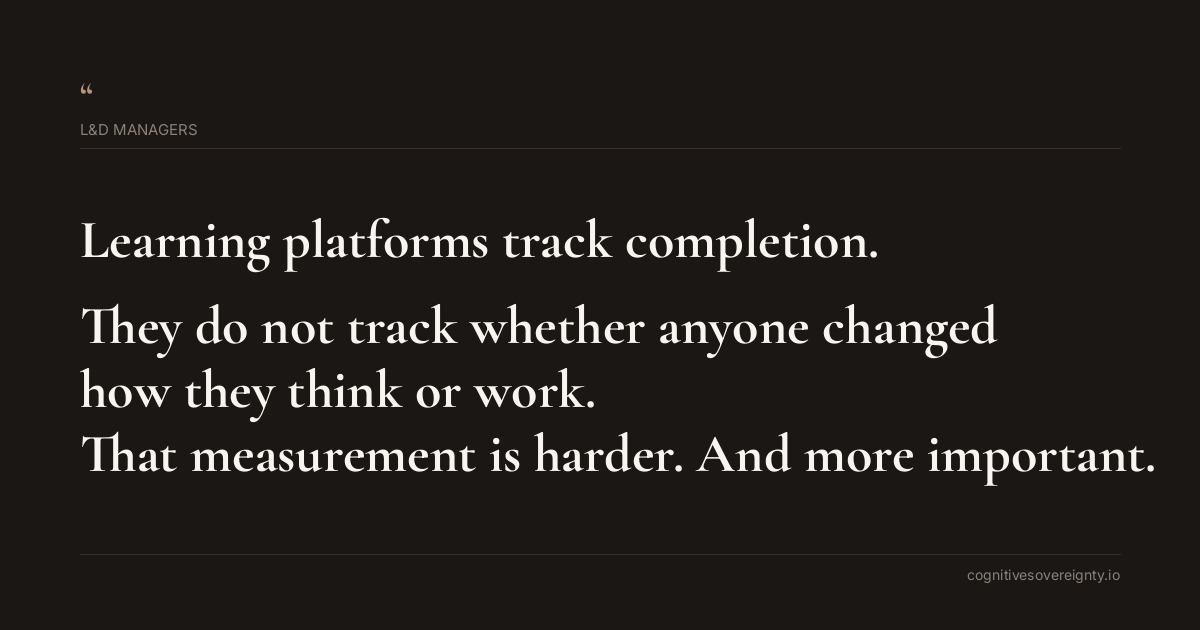
Stop measuring learning by Coursera completion rates or LinkedIn Learning badges. Measure whether employees can make sound decisions about when to use AI, when to do the work themselves, and how to verify the result.
Create role-specific prompting standards that force thinkingintermediate
A vague prompt to ChatGPT produces a vague response. Teach your team to write prompts that require them to first clarify what they actually need. The discipline of prompt writing becomes a form of thinking.
Document what decisions AI tools cannot make in your organisationbeginner
List the choices that must remain human: hiring decisions, strategy changes, customer disputes, anything that depends on organisational values. Make this list explicit in your training so people know where their judgement is non-negotiable.
Redesign leadership development to prevent cognitive outsourcing
Teach leaders to recognise the difference between AI adoption and AI dependencyintermediate
Adoption means choosing when to use a tool. Dependency means using it by default because thinking feels harder. Your leadership programme should help managers spot this in their teams and interrupt it.
Coach leaders to ask 'Why would this decision be harder without AI?' in team meetingsbeginner
This one question surfaces whether people understand the thinking behind the work or are just following the tool. Leaders who ask this regularly train their teams to think independently.
Build case studies where AI gave the wrong answer because the human did not think firstintermediate
Use real failures from your organisation or industry. Show how people trusted the AI output without applying their own judgement. This makes cognitive sovereignty concrete for leaders.
Create accountability for preserving team capability, not just AI proficiencyadvanced
Include in performance reviews whether leaders are ensuring their teams can still do core work without tools. Make capability preservation a measurable leadership responsibility.
Teach leaders to rotate tasks so no one becomes the AI operatorbeginner
When one person does all the prompting and shares results, the team atrophies faster. Leaders should ensure different people practice the thinking work, even if it takes longer.
Design mentoring relationships that cross AI tool boundariesintermediate
Pair experienced employees who learned the skill manually with newer hires who know only the AI version. This transfers tacit knowledge that tools cannot capture.
Measure genuine learning, not content completion
Stop using course completion as proof of learningbeginner
Degreed, Docebo, and Coursera all tell you who finished. They do not tell you who learned. Create post-course assessments that measure whether people can apply what they learned when AI is not available.
Audit your learning platform metrics for cognitive riskadvanced
Review what your LMS measures. If it counts time spent on 'AI best practices' modules but not employee ability to make judgements without prompts, your measurement system is hiding the problem.
Design pull tests instead of push tests for AI literacyadvanced
Instead of asking employees to take a course on prompt engineering, put them in a work situation where they must solve a problem without clear guidance on which tool to use. Measure what they choose and why.
Track the time it takes for employees to produce work without AI toolsintermediate
If it takes much longer than before or people cannot do it at all, they are cognitively dependent. Measure this quarterly as a leading indicator of capability loss.
Create assessments that measure confidence in human thinking, not just tool confidenceintermediate
Ask employees how confident they are making a decision without AI help, and separately how confident they are using AI. A widening gap signals growing dependency.
Require learning designers to justify why each AI tool is in your curriculumbeginner
Too often tools are added because they exist and are free. Your team should argue for each one: What skill does this preserve? What thinking does it develop? What happens if we remove it?
Measure retention of foundational skills separately from tool proficiencyintermediate
Divide your assessment scores into two categories: work quality without tools and work quality with tools. Track both trends. If one drops, you have a problem.
Five things worth remembering
- Require your learning designers to work through every AI tool-based course without the tool first. If they cannot design the manual version, they cannot design the AI version responsibly.
- Audit your Degreed and Docebo dashboards for a specific danger sign: high completion rates paired with low application of learning in actual work. This mismatch signals training that teaches tool use, not thinking.
- Interview five employees who have completed your AI literacy programme. Ask them to solve a real problem in their role without using their AI tool. Listen for whether they know where to start or if they freeze.
- Create a 'capability inventory' for each role: list the five to seven core thinking skills people must keep. Map which of your current training programmes actually build these skills versus which just teach tool operation.
- When designing leadership development on AI adoption, include one scenario where an AI tool gives an answer that is technically correct but strategically wrong. See whether leaders catch it. If not, your programme is missing something essential.
Common questions
Should l&d managers map the core cognitive skill your ai tool replaces?
Before adding ChatGPT or another AI tool to your curriculum, name the thinking skill employees must do first. If the tool writes reports, employees must learn to plan what a report needs. If the tool codes, they must understand the logic before prompting.
Should l&d managers build a three-stage sequence: manual practice, then tool use, then critical review?
Start with people doing the work without AI. Then introduce the tool. Then teach them to assess whether the tool's output is correct or useful. Skipping the first stage creates workers who cannot spot when AI fails.
Should l&d managers require employees to produce work without their ai tool once per month?
This is not punishment. It is the only way to know whether people have kept their own capability or only borrowed the tool's. Use these exercises to identify who is at risk of cognitive atrophy.